Open Day at Tel Aviv University

Open Day at TAU: Choose the Unconventional, Combine Your Passions

Thousands came to discover how they can combine their areas of interest in their studies.

The winter weather, which decided to visit us in Tel Aviv for only a few hours, added to the festive atmosphere of the Open Day held on February 6th at our campus. Thousands of prospective students gathered to learn about admission requirements and the registration process, and to meet with academic and administrative staff as well as current students from the fields they are interested in. They found themselves congregating in the faculty buildings across campus and in the registration and counseling halls, where they were greeted with workshops, lectures, and panels—everything they needed to begin their academic journey.

Throughout the day, attendees had the opportunity to ask questions and discover information about the diverse study program combinations offered by Tel Aviv University.

“The university offers over 200 study programs, and is part of a movement to create innovative interdisciplinary programs”, says Sharon Ariel, the university’s marketing director.

She continues: “We encourage our students to choose unconventional combinations, believing they will find ways to integrate their different areas of interest throughout their professional and personal lives. For example, students can study Biology alongside Philosophy, combine Computer Science with Music, or deepen their understanding of Law and Film Studies. This approach allows each student to find their unique path and fully realize their academic and personal potential”.

This year, Tel Aviv University also introduced special conditions for reservists who were called up for extended periods, as well as for evacuees from war zones, offering a unique undergraduate admission track to help them succeed. Visitors to the Open Day participated in immersive tours through the faculty buildings and study departments, offering a taste of various fields of study and a glimpse into the different labs. The first 200 registrants at the event received a special surprise—a pair of Saucony running shoes as a gift.

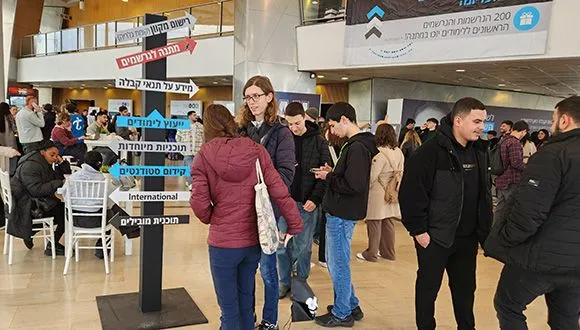
Open Day at TAU. Photo credit: LENS Productions.

Among the most popular sessions were those introducing Tel Aviv University’s innovative teaching methods, including virtual reality experiences and workshops on choosing a field of study from the Career Counseling Center at the Dean of Students’ Office. In addition, prospective students learned about the opportunity to spend a whole semester at leading universities abroad through the student exchange program, and participated in a workshop at the Campus Entrepreneurship Center, where they learned how to start advancing their startup dreams during their degree.

We were delighted to host everyone at our beautiful campus, and we hope that together with us, the prospective students will begin their journey toward the discoveries, innovations, and theories waiting to be uncovered.

Couldn’t make it to Open Day and Interested in TAU’s International Track? All the information about admission pathways and what needs to be done to start studying at Tel Aviv University is available on the TAU International website >

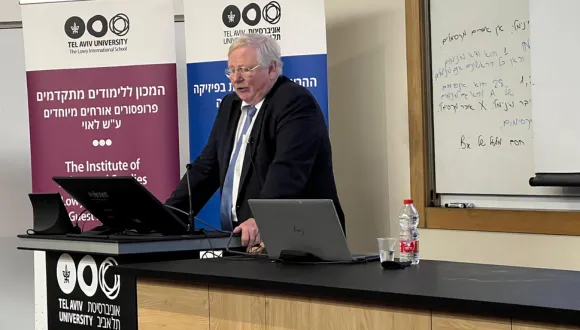
Nobel Laureate Reinhard Genzel delivering a lecture at TAU's annual Physics Colloquium

Main Nobel Laureate Reinhard Genzel Visits TAU as a Lowy Distinguished Guest Professor

Unveiling the Universe’s Mysteries

In January, Tel Aviv University (TAU) hosted Nobel Laureate Professor Reinhard Genzel for a lecture on recent advancements in understanding black holes and their role in shaping galaxies, as part of TAU’s annual Ne’eman Physics Colloquium. Genzel visited under the auspices of the Lowy Distinguished Guest Professors framework, made possible by The Lowy International School.

During his visit, Genzel also participated in a podcast discussion with his host and longtime colleague Prof. Amiel Sternberg, from TAU’s School of Physics and Astronomy; the two delved into how Genzel’s research career developed, including what led him to ultimately discover a compact object at the center of the Milky Way and win the 2020 Nobel Prize in Physics.

In the podcast episode, Genzel also details his long history of collaboration with his Israeli colleagues, reflecting, for instance, on a recent three-day symposium in December that brought together top German and Israeli science organizations and universities: “It was fantastic to see how much we appreciate each other,” he said.

Similarly, Genzel began his lecture, Massive Black Holes & Galaxies: Experimental Evidence & Cosmic Evolution, by emphasizing the decades-long connections he has had with Israeli research institutions. “I am absolutely proud, as a German and as a scientist, to have had that companionship,” said Genzel, who was officially representing the Max Planck Society. “In difficult times, I think it’s important to stand by your side.”

The Mystery of Black Holes

The focus of Genzel’s talk was the enigmatic nature of black holes, particularly the supermassive black hole at the heart of the Milky Way Galaxy, called Sagittarius A*. He explained that black holes, first predicted by Einstein’s general relativity, were initially theoretical. However, through years of patient observation and technical innovation, scientists started to gather direct evidence of their existence. “The question was … do they really exist, and can we prove it?” Genzel remarked.

“It’s mind-boggling that three different techniques – observations with high resolution of gas and stars, gravitational waves and also very high-resolution short wavelength radio interferometric observations – have in the last 10-15 years really pushed this topic from pure speculation to scientific truth.”

Genzel highlighted, for instance, the breakthrough observations of stars orbiting Sagittarius A* at incredible speeds, reaching thousands of kilometers per second. These stellar orbits provided compelling evidence of a supermassive object. “We can see [these stars] moving night to night … and how they orbit,” he explained. “That’s incredible … and it gives us very precise information on the mass.”

The Galactic Center and Cosmic Evolution

The lecture also delved into the relationship between black holes and galaxy formation. Genzel discussed how black holes accumulate material and release energy, shaping the environments around them. By studying active galactic nuclei in distant galaxies, researchers have traced the growth of black holes and their co-evolution with their host galaxies, with the ratio of the black hole’s mass to the galaxy’s mass roughly constant.

He also shared intriguing results from gravitational wave astronomy, which has revealed new insights into stellar black holes, which suggest that black holes might grow faster or through additional processes than previously thought. “All of this is on the table right now,” Genzel stated. “Of course, that will be the goal of understanding the story in the next 10 years.”

Future Prospects

Looking ahead, Genzel emphasized the need for more advanced instruments to probe black holes further. He described how future experiments with gravitational waves and next-generation telescopes, for instance, could help resolve some of the field’s most perplexing questions. As part of this, Genzel pointed to the recent discovery of a star orbiting in the vicinity of Sagittarius A*, something which suggests that a black hole’s gravitational force may not be as destructive as previously understood.

Genzel ultimately ended his talk by encouraging the future generation of researchers to take up the mantle, including those attending the colloquium: “Come on, join the crowd,” he told them. “This is exciting stuff.”


Interested in The Lowy Distinguished Guest Professors framework and how it helps to bring eminent scholars to TAU? Learn more here.

Victoria

Phone: +61 3 9296 2065
Email: office@aftau.asn.au

New South Wales

Phone: +61 02 7241 8711
Email: admin@aftau.org.au

Western Australia

Phone: :+61 0418 46 5556
Email: davidsolomon@aftau.org.au