

TAU Co-Study: “Green Revolution” Decreased Infant Mortality
“Israel, as a global leader in agriculture R&D, has much to offer to the developing world.”
In the first global-scale study of its kind, researchers used wide-scale data to correlate between the “Green Revolution” in agriculture and the dramatic reduction in infant mortality in the developing world. The Green Revolution was a global effort to increase the global crop yield during the second half of the twentieth century.
“In our study, we sought to use empirical methods based on our hypothesis that larger crop larger yields could improve the level of nutrition of pregnant women and young children, and also increase household income, thus contributing indirectly to improved health,” explained Dr. Fishman, of the TAU Department of Public Policy and the Boris Mints Institute for Strategic Policy Solutions to Global Challenges, who contributed to the research. “During the Green Revolution, there was support for international public agricultural R&D with a focus on developing higher-yielding strains of common staple crops, such as wheat, rice, and corn. By the end of the 20th century, approximately 60% of the developing world’s agricultural lands were using these varieties.”
At the same time, between 1960 and 2000, there was a dramatic improvement in health in the developing world- the percentage of children who died before the age of one was reduced from 20% to 10%. The cause of this improvement has been long-contested and attributed to various public health improvements but the contribution of individual factors, including the impacts of the Green Revolution, has been poorly quantified until now.
The correlation in the study suggests that the Green Revolution was responsible for a decline of some 2.5- 5% in the rate of infant mortality. This represents between 25% to 50% of the overall reduction of infant mortality during that time period.
To conduct the study, the researchers collected detailed data about the mortality rates of 600,000 infants born in 37 developing countries between 1961 and 2000, and cross-referenced them with information about the diffusion of the improved Green Revolution seeds in the place and year of birth of each of these infants. Using sophisticated statistical methods, they estimated the association between these two variables. The analysis found a statistically significant causal link between the two data sets. In locations where improved varieties diffused earlier – in part because of the types of crops grown, there was also a more rapid decrease in mortality rates.
“Our study proves the historical importance of agricultural R&D for the health of the rural populations in the developing world. We showed that improved crop varieties, which thus improved nutrition and income and reduced hunger, saved the lives of tens of millions of children in the second half of the twentieth century, and have most likely also brought about improved health for tens of millions of other individuals not directly visible in the data,” said Dr. Fishman.
According to Dr. Fishman, these findings highlight the continued need to address public health. “Israel, as a global leader in agriculture R&D, has much to offer to the developing world,” he says.
The study was conducted by an international team of researchers from Tel Aviv University, the Indian School of Business, the World Bank, the University of California San Diego, Michigan State University, and Colorado State University. The paper was published in the Journal of Health Economics.
Featured images: TAU Prof. Ram Fishman and agricultural expert Omar Zaidan explain seedling use to farmers in India. Credit: the Nitzan Lab


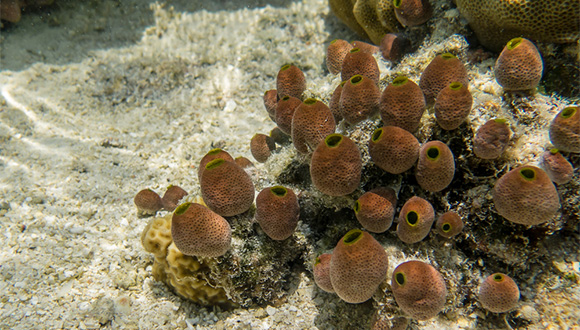 Did they take their medicine today? Ascidians
Prof. Shenkar and the researcher Gal Navon explain that various pharmaceuticals consumed by humans are not fully metabolized in the body, and high percentage of their active compounds are later excreted in their original form. In addition, lack of public awareness often results in the disposal of unused drugs in toilets or home garbage bins. Currently existing sewage treatment facilities are not suitable for the treatment of medication residuals, and, unlike other pollutants, their final concentrations at the endpoint of sewage treatment are not monitored. Eventually, a substantial amount of pharmaceuticals is discharged into the sea by sewage water. According to the research team, a variety of pharmaceutical residuals can be found in marine ecosystems worldwide – antibiotics, anti-inflammatory drugs, analgesics, anti-depressants and many more.
“Many of these compounds are very stable”, the researchers say, “These take a long time to degrade in the marine environment, and the damage they cause to marine life could be extremely excessive, since these pharmaceuticals are designed to affect biological systems (the human body). For example, various studies performed in different sites around the world have shown that Estrogen, present in birth control pills, leads to the development of female features in male fish in certain species, thus damaging their fertility; Prozac triggers increased aggressiveness and risk-taking in crustaceans; anti-depressants impair memory and learning in cuttlefish, and more”.
Prof. Avisar: “We have been studying the chemo-physical fate of drug residuals in groundwater and surface water for the past 15 years, and their detection in marine ecosystems has been surprising. The results indicate a chronic large-scale pharmaceutical residuals contamination, as well as the absorption of micro- and nano-pollutants, measured at very low concentrations in marine organisms”.
“Our study shows that Israel is no stranger to the global serious issue of seawater pharmaceutical contamination.”, Prof. Shenkar concludes. “The medications we use end up in the sea, mainly through sewage discharge, and cause great damage to the marine environment, indirectly affecting humans, who feed on sea foods that are exposed to such contamination. There are different ways to tackle this problem: on the individual level, we recommend that the population as a whole takes personal responsibility, disposing of unused pharmaceuticals into designated containers – which can be found at pharmacies and health maintenance organizations’ facilities. In addition, we are working to expand research on monitoring pharmaceutical contamination along the Israeli coastline, using advanced analysis of a greater variety of widely used medication, while examining the changes exerted upon the various organisms exposed to the environmental concentrations of those pharmaceuticals”.
Did they take their medicine today? Ascidians
Prof. Shenkar and the researcher Gal Navon explain that various pharmaceuticals consumed by humans are not fully metabolized in the body, and high percentage of their active compounds are later excreted in their original form. In addition, lack of public awareness often results in the disposal of unused drugs in toilets or home garbage bins. Currently existing sewage treatment facilities are not suitable for the treatment of medication residuals, and, unlike other pollutants, their final concentrations at the endpoint of sewage treatment are not monitored. Eventually, a substantial amount of pharmaceuticals is discharged into the sea by sewage water. According to the research team, a variety of pharmaceutical residuals can be found in marine ecosystems worldwide – antibiotics, anti-inflammatory drugs, analgesics, anti-depressants and many more.
“Many of these compounds are very stable”, the researchers say, “These take a long time to degrade in the marine environment, and the damage they cause to marine life could be extremely excessive, since these pharmaceuticals are designed to affect biological systems (the human body). For example, various studies performed in different sites around the world have shown that Estrogen, present in birth control pills, leads to the development of female features in male fish in certain species, thus damaging their fertility; Prozac triggers increased aggressiveness and risk-taking in crustaceans; anti-depressants impair memory and learning in cuttlefish, and more”.
Prof. Avisar: “We have been studying the chemo-physical fate of drug residuals in groundwater and surface water for the past 15 years, and their detection in marine ecosystems has been surprising. The results indicate a chronic large-scale pharmaceutical residuals contamination, as well as the absorption of micro- and nano-pollutants, measured at very low concentrations in marine organisms”.
“Our study shows that Israel is no stranger to the global serious issue of seawater pharmaceutical contamination.”, Prof. Shenkar concludes. “The medications we use end up in the sea, mainly through sewage discharge, and cause great damage to the marine environment, indirectly affecting humans, who feed on sea foods that are exposed to such contamination. There are different ways to tackle this problem: on the individual level, we recommend that the population as a whole takes personal responsibility, disposing of unused pharmaceuticals into designated containers – which can be found at pharmacies and health maintenance organizations’ facilities. In addition, we are working to expand research on monitoring pharmaceutical contamination along the Israeli coastline, using advanced analysis of a greater variety of widely used medication, while examining the changes exerted upon the various organisms exposed to the environmental concentrations of those pharmaceuticals”.


