Will Biden Lose Congress?
Next week’s elections in the U.S. will be critical. Tel Aviv University researchers explain why.
The U.S. 2022 midterm elections on November 8 are fast approaching, but if a new President is not on the menu, then why should we care?
In the U.S. midterms, Americans vote on representatives in Congress, the legislature of the federal government
Congress is made up of the Senate and the House of Representatives, whereby the Senate consists of 100 Senators who represent the interest of the state, and the House of Representatives consists of 435 Members of the House who represent their local populations.
The entire House of Representatives is up for elections – as is one third of the Senate (each midterm a different third).
In addition, state governors, state legislatures and local gov. officials are running for office in various U.S. states.
Biden’s Downfall?
“The 2022 midterm elections are important,” says Dr. Yoav Fromer, Head of the Center for the Study of the United States at Tel Aviv University, “exactly because of the 2024 elections. The prospects of President Biden possibly loosing either the Senate or the House – or both – means that he may be disabled by the Republican Congress in the next two years. This would prevent him from following up on many of the promises that he has made – including his ‘Build Back Better Plan’, along with initiatives related to climate action, education, expanding government-run healthcare programs, and more. If this will be the case,” he says, “Biden won’t have much to show for in 2024.”
Both houses of Congress are currently controlled by the Democratic party, and while the majority is very small, it has been sufficient for Biden, a Democrat – whose initiatives must be approved by Congress first – to execute his policies. The Republicans need to win only five more seats in the House and one more in the Senate to gain control. A Republican majority in either chamber would make it much easier for them to block Biden’s plans going forward.
What is the prognosis for this to happen? Dr. Lior Sheffer from TAU’s School of Political Science, at the Gershon H. Gordon Faculty of Social Sciences, is an expert on elections, voter behavior and polls. He explains that typically, the party that holds the White House tends to lose seats in the midterm. “This prognosis,” he says, “is indeed supported by the polls ahead of the 2022 election midterms: The Republicans are currently leading in polls and will most likely get a majority in the House of Representatives. As for the Senate, polls show that there’s a very small chance that Democrats will have a slight majority after the midterms.”
“It is sufficient for Republicans to get a majority in the House of Representatives and they will be able to hamper the Democrats’ agenda over the next two years.” Dr. Lior Sheffer
“However, this could quickly change, depending on a few local races in various states, such as Michigan, Pennsylvania, Wisconsin, North Carolina or Arizona.” He adds that “It is important to note that it is sufficient for Republicans to get a majority in the House of Representatives and they will be able to hamper the Democrats’ agenda over the next two years.” Moreover, Sheffer says that “if the 2020 polls serve as an indicator, the victories of the Republicans in both houses could be significantly greater than predicted.”
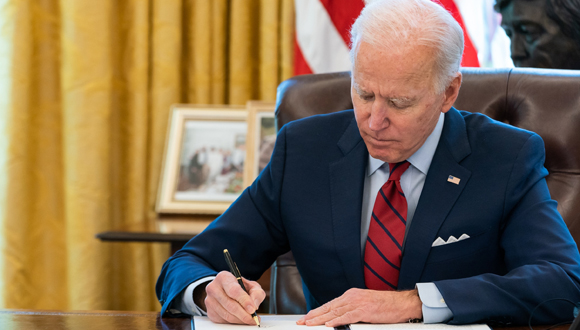
Will U.S. President Joe Biden be disabled in the next two years?
Towards Civil War?
“In addition,” says Fromer, “the local state elections are more important than ever. In the 2020 elections, we learnt how Secretaries of state can choose to reject votes [so-called “election deniers”], and Trump would indeed try to convince them to do so. While no one ended up acting on this in 2020, these ‘election deniers’ could end up being elected [in the 2022 races] and try to influence the outcome of the presidential campaign in 2024, which could lead to a Constitutional crisis.”
“In the U.S., there has always been an agreement on the rule of law. Whenever someone lost in elections, he would step down peacefully. This came close to an end in 2020, with the refusal by Trump and his supporters to accept the election results.” Dr. Yael Sternhell
Dr. Yael Sternhell, head of the American Studies Program at Tel Aviv University elaborates further on the threats which U.S. democracy is currently facing, pointing out that today, about 70% of Republican voters suspect there was election fraud in the 2020 elections. “In the U.S.,” she says, “there has always been an agreement on the rule of law. Whenever someone lost in an election, they would step down peacefully. This came close to an end in 2020, with the refusal by Trump and his supporters to accept the election results. This has had a surprisingly lasting effect on Americans.”
“Will we live to see another big upheaval, like the Civil War in 1861? What would be indicators of this?” asks Sternhell, offering: “Do we begin to see House Representatives who refuse to accept election outcomes? Will that be the ‘new normal’? Will it be followed by violence? There are lots of guns circulating in the U.S… Will the Republicans accept a defeat in the midterm elections if that happens? These would be critical indicators,” she concludes.
Protecting U.S. Democracy
If the notion of midterm elections has you confused, that’s understandable. Fromer shares that, “those who vote in the midterms tend to be people who are politically engaged in general, with special interests and/or who are involved through political parties, social or religious affiliations.” Midterm elections are typically more focused on state-level interests.
“The Founding Fathers wanted a strong centralized government upholding law and order (…) they also wanted an expression of democracy which allowed the crowd to rule without degenerating into anarchy.” Dr. Yoav Fromer
While less sexy and straightforward than presidential elections, these biennial elections have been held since the first U.S. presidential elections (in 1788), and can be argued to be the most important ones. According to Fromer the role of midterm elections is and has always been, to protect U.S. democracy: “The Founding Fathers wanted a strong centralized government upholding law and order on the one hand, and on the other hand, they also wanted an expression of democracy which allowed the crowd to rule without degenerating into anarchy. Midterm elections was the mechanism chosen to ensure this balance.”
Regular midterm elections, they figured, would prevent the acting president from organizing congressional elections whenever it suited him and ensure that the Members of Congress would have “an immediate dependence on, and an intimate sympathy with, the people.” Midterm elections were to function as a guarantee against tyranny.
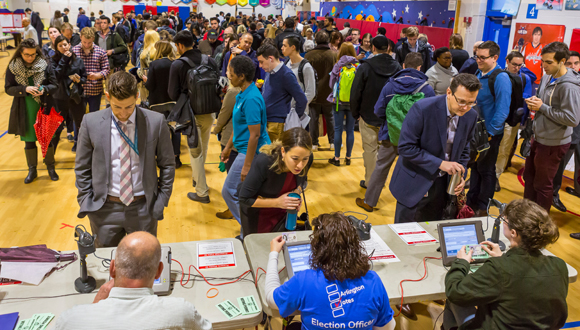
Election officials check voters’ identification during midterm election voting in Virginia, USA (2018)
Powerful Indicator
The U.S. midterm elections play an important role in the American democracy and serves as a powerful indicator of what will follow in the next two years, as well as in the 2024 presidential elections. Those of us with an interested in American or world politics, therefore, ought to monitor next weeks’ midterm elections closely.
Featured image: Washington, DC – January 6, 2021: Protesters seen all over Capitol building where pro-Trump supporters riot and breached the Capitol