Prof. Isaac P. Witz Honored with 2023 Szent-Györgyi Prize for Progress in Cancer Research

Renowned Tel Aviv University Professor Emeritus recognized for his groundbreaking scientific contributions.

An Impressive achievement: Professor Isaac P. Witz from the Shmunis School of Biomedicine and Cancer Research at Tel Aviv University’s George S. Wise Faculty of Life Sciences, was chosen by the prize selection committee of the National Foundation for Cancer Research (NFCR) in the US to receive the prestigious Szent-Györgyi Prize for his groundbreaking scientific contributions.

Groundbreaking Discoveries

The prize will be given to Prof. Witz, a distinguished figure in cancer research, whose work has shed light on the crucial role of reciprocal information flow and signaling between cancer cells and the tumor microenvironment (TME) for understanding tumor formation, progression and metastasis. The annual Prize honors scientists whose seminal discovery or pioneering body of work has contributed to cancer prevention, diagnosis, or treatment and has had a lasting impact on understanding cancer, holding the promise of improving or saving lives of cancer patients. In recognition of his achievements, Professor Witz will receive the award at a ceremony scheduled for October 21, 2023, at The National Press Club in Washington, D.C.


“I am filled with immense gratification knowing that my contributions have shaped current understanding of the TME and laid the foundation for life-saving immunotherapies for patients.”– Prof. Isaac Witz


Professor Isaac Witz expressed his profound satisfaction, stating: “I am filled with immense gratification knowing that my contributions have shaped current understanding of the TME and laid the foundation for life-saving immunotherapies for patients. It is an absolute honor, and I am overwhelmed with joy and gratitude towards the 2023 Szent-Györgyi Prize Selection Committee for bestowing upon me this prestigious recognition, allowing me to stand alongside the esteemed previous recipients of the Szent-Györgyi Prize.”

With an outstanding career spanning over fifty years, Professor Witz currently serves as Professor Emeritus at Tel Aviv University and heads the Laboratory of Tumor Microenvironment & Metastasis Research at The Shmunis School of Biomedicine and Cancer Research, George S. Wise Faculty of Life Sciences. Throughout his career, he made significant contributions through breakthrough observations, discoveries, publications, and collaborative efforts, emphasizing the critical role of the TME in cancer cell biology, growth, and metastasis.

Impactful Research

During the early stages of his scientific journey, in the 1960s, Professor Witz pioneered the TME concept by an experimental demonstration that components of the immune system infiltrate the TME, impacting tumor behavior. His research established that humoral immune factors localized in the TME exert pivotal roles on various manifestations of anti-tumor immune responses. These seminal findings laid the groundwork for certain aspects of contemporary life-saving immunotherapies, ultimately benefiting cancer patients and advancing scientific progress towards finding cures for cancer.

Rakesh K. Jain, Ph.D., Chair of the 2023 Selection Committee and the 2022 Prize recipient, expressed his delight at Professor Witz’s selection, highlighting the impact of his work on the development of cancer therapeutics targeting molecules within the TME. Dr. Jain, whose own research encompasses the field of TME, believes that future opportunities for life-saving therapies will continue to emerge from this area of study.

What the Ukraine Crisis Means for Cyber Warfare

What the Ukraine Crisis Means for Cyber Warfare.

While Russia’s invasion of Ukraine rapidly unfolds, we sat down with Omree Wechsler, a senior researcher in TAU’s Yuval Ne’eman Workshop for Science, Technology and Security, to discuss the cyber security aspects of the conflict in Ukraine.

Omree, Ukraine’s vice prime minister recently said the country had launched an ‘IT army’ to combat Russia in cyberspace. How would you assess Ukraine’s cyber capabilities? 

Several attempts were actually made to assess the national cyber power of states, however, Ukraine was not among them due to the lack of data. While the research community is still in the dark about Ukraine’s cyberspace capabilities, we can assume that due to the fact that Ukraine was targeted by Russian cyberattacks ever since the annexation of Crimea, their cyber defense teams should be highly experienced.

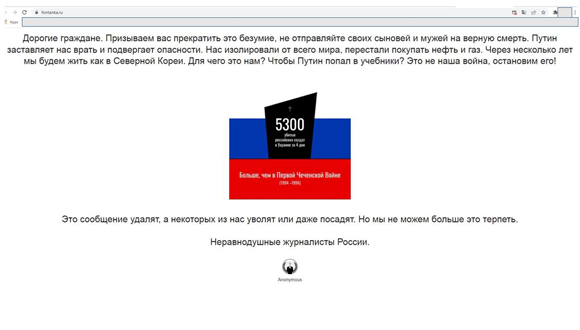
The Ukrainian government has called upon the country’s hacking community to help protect their infrastructure, conduct espionage and disruptive activities against Russian forces. In addition, certain international hacking collectives (such as Anonymous) declared that they would act against Russian targets.

Screenshot from a popular St. Petersburg news outlet (https://www.fontanka.ru/): On February 28, several Russian news sites were attacked, warning readers not to "send their sons and husbands to certain death.” Anonymous claimed responsibility


Screenshot from a popular St. Petersburg news outlet (https://www.fontanka.ru/): On February 28, several Russian news sites were attacked, warning readers against “sending their sons and husbands to certain death.” Anonymous claimed responsibility

The official website of the Kremlin, the office of Russian President Vladimir Putin, kremlin.ru, crashed a few days ago (it is still down at the time of writing). Who is behind this attack?

The kind of attack we see on Russian official websites is called a ‘Denial of Service’ cyberattack (or DDoS). It’s a relatively easy task, and does not require sophisticated cyber expertise. Looking at past cyberattacks that were attributed to Western governments, mostly the U.S. Cyber Command, it does not seem that this is an instance of Western retaliation (Western cyberattacks would in theory look more like disabling military systems and so on), but rather the work of “hacktivists” – hackers who employ their capabilities as part of their social/political agenda. It could also be the work of Ukrainian hackers who took advantage of the opportunity to hit some symbolic target.

The power is no longer reserved for the state, then?

That’s correct. There are many other actors with access to cyber capabilities of varying complexity. However, advanced capabilities require means, such as money and expertise. Therefore, the most capable threat actor in this regard remains the state. It is also important to mention that cyber capabilities render factors such as population and geographic size, that are essential for conventional military might, obsolete.

I think that in the current conflict, international hackers or hacktivists could mostly embarrass the Russian government and cause some disruptions. One way that international hackers could cause damage to Russian targets is by ransomware attacks that encrypt data thus making it unreadable to the systems that use it. Another may include leaking highly sensitive or classified data that will be used by more sophisticated groups for more sophisticated attacks. However, the damage they can cause is usually limited compared to the capabilities of Western governments. 


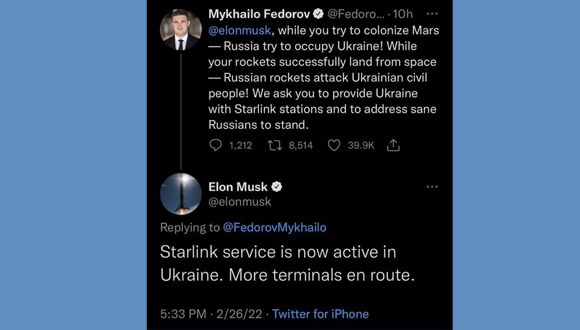
The Russian invasion disrupted Ukraine’s internet connectivity, but the country has successfully mobilized public opinion with the help of social networks, and its Vice Prime Minister Mykhailo Fedorov asked billionaire Elon Musk through Twitter to make available his company’s Starlink satellite broadband service in Ukraine. Musk delivered.

What type of cyber operations have been employed in this conflict? 

Before the military attacks, the Russians also used DDoS attacks and flooded Ukrainian government and banking websites. Other attacks employed so-called ‘wipers’, a malware that deletes data and renders computers unusable. There are plenty of tools in the cyber toolbox.

What were the Russian objectives of the cyberattacks? 

In January, some experts argued that the attacks’ objective was to steal information relevant to an upcoming invasion. DDoS attacks may have been used for diversion, while the wiper attacks prevented the Ukrainian government from quickly recovering by deleting data and preventing machines from booting.

The Russians also did their best to wreak fear and doubt among Ukrainian citizens and to embarrass the Ukrainian government. These attacks were accompanied with a constant disinformation campaign including reports on Ukrainian aggression in Eastern Ukraine.

Did it work?

There is no evidence that the attacks destabilized the public support for the Ukrainian government, inside Ukraine or abroad. It may seem that some of the Russian disinformation was also directed at local Russian citizens in order to increase support for the attack. There is still no indication that it worked, as reports on Russian soldiers that have been compelled to invade Ukraine are coming in.


Omree Wechsler

Should we expect more cyberattacks from Russia? 

I believe Russian aggression in cyberspace will continue, in order to support its military operations. Cyberattacks that cripple the electric grid, water systems and other critical infrastructure are even more possible, given the fact that many critical systems in Ukraine use Russian technologies and software. A prime example, is Ukraine’s electrical grid which was built during Soviet times. It is very likely that many more malware infections are lying dormant in Ukrainian systems, ready to be deployed.

Russian threat actors will likely direct their cyber efforts against NATO and EU member states as well, in retaliation for supporting Ukraine and announcing sanctions. In fact, banks, critical infrastructure operators, government and public administration agencies in Europe and in the U.S. have been on alert for a while. Earlier this month, oil and fuel supply companies in Germany, the Netherlands and Belgium were hit by ransomware and forced to work in limited capacity. These attacks were attributed to a Russian-speaking group named ‘BlackCat,’ and, given that all these countries have in common that they are NATO member states that agreed to send troops and aircraft to countries surrounding Ukraine, it is difficult to decouple the attacks from the crisis in Ukraine.

Will the West remain idle? 

Apart from sanctions, it is possible that the West will employ cyberattacks. According to reports, U.S. President Joe Biden was presented with various options to carry out cyberattacks aimed at disrupting the Russian invasion. The UK Defense Secretary, Ben Wallace, stated that the UK may launch cyberattacks on Russia if it targets the UK networks. However, given their sensitive position, Western responses in cyberspace are likely to be limited and reactive. It really depends on the purposes and gains they wish to achieve.

Theoreticians have long tried to define how cyberattack operations can be utilized amid political and military conflicts, and whether they stand on their own or support conventional military operations. The Russian invasion of Ukraine and the months preceding, therefore, are bound to be investigated as case studies necessary to understand the nature of cyberwarfare operations.

And Let There Be Light

Efforts by TAU’s Clinical Law Program will help keep electricity running for those who are struggling to pay utility bills.

The recent drop in temperature in Israel has led to a significant increase in electricity consumption. But what about those who simply cannot afford basic necessities?

A petition jointly filed by Tel Aviv University’s Human Rights Clinic at The Buchmann Faculty of Law will help keep the electricity on for some of Israel’s most underprivileged populations. In response to the appeal, Israel’s High Court ruled that electricity must not be cut off for citizens who prove a difficult economic or medical condition, effective immediately. We spoke with attorney Adi Nir Binyamini from TAU’s Human Rights Clinic, one of the lawyers who handled the case. 

Electricity – A Fundamental Right?

In a precedent-setting decision, the High Court ruled on January 20 that access to electricity should be considered a fundamental right and that the Electricity Authority must, within six months, amend the criteria for power outages as a means of collecting debt. Meanwhile, the new ruling assists electricity consumers who find themselves in serious economic or medical distress, and ensure that they will not be left in the dark or the cold and without other basic needs.

The ruling came in response to a petition filed by the Association for Civil Rights in Israel (ACRI) in collaboration with the Human Rights Clinic at Tel Aviv University, Physicians for Human Rights and the Israel Union of Social Workers against the Electricity Authority, the Israel Electric Corp. and Energy Minister. It was filed on behalf of several poor families whose electricity had been cut off for non-payment.

The High Court of Justice ruled that, until the Electricity Authority establishes appropriate criteria and procedures (within six months from the time of the ruling), it must enable consumers facing power cuts from lack of payment to demonstrate whether they are suffering financial or health problems that justify their continued access to electric power. The court said the Electricity Authority must conduct a hearing prior to cutting a customer’s power. It gave the national electricity provider six months to revise its procedures and ordered it to pay the petitioners 40,000 NIS ($12,800) in expenses, to be divided among them. “This is a dramatic change from the previous situation, when it was possible to cut off people’s electricity access due to the accumulation of debt, except for very few exceptions,” explains Att. Nir Binyamini.


From the second hearing in Higher Court, on October 28, 2021 (from left to right): Gil Gan Mor (ACRI), Hicham Chabaita and Att. Adi Nir Binyamini from TAU’s Human Rights Clinic and Att. Mascit Bendel (ACRI) 

The Beginning of a New Era

Binyamini, who has dealt with electricity litigation for several years now, says, “I feel personal and professional satisfaction that on the coldest day of the year, when people were left without heating, the High Court accepted our position and ruled not to cut off people’s electricity due to poverty and that debt must instead be collected by more moderate means.”


 When asked how the Clinic got involved with the project, Binyamini explains that TAU’s Humans Rights Clinic was previously part of a legal battle over water disconnections for consumers unable to pay their water bill. “After that was successfully completed, we took on the subject of electricity and have been working on it continuously for the past eight years. The Clinic represented and handled the two petitions that were submitted to the Israeli High Court, and over the years we have dealt with hundreds of individual cases of people being cut off from electricity. We have also been guiding and assisting social workers with individual cases.”

She adds that a large number of students from the Clinic have worked on the case over the years, and stresses that such practical experience is an extremely valuable component of legal education.

Upon the court’s ruling, Binyamini along with Att. Maskit Bendel of the ACRI issued a statement, saying: “We hope that the ruling, which opened with the words ‘and let there be light,’ heralds the beginning of new era when it comes to protecting weak populations from having their electricity cut off.” 


Attorney-at-law Adi Nir Binyamini from Tel Aviv University’s Human Rights Clinic (photo: Tomer Jacobson) 

Reading Tea Leaves

What is the origin of tea, and does the climate crisis threaten its production?

Tea – the ancient beverage comes in different flavors and colors. The Queen of England will never go without her afternoon tea, in India it’s enjoyed with milk and spices and we all like to pour ourselves an occasional cup of Earl Grey, especially when winter comes knocking. But have you ever wondered whether the saying “all the tea in China” really does indicate where tea drinking started? Or if the soothing drink may be affected by the climate crisis? Should we, in fact, be drinking it? We have, and our researchers explained, surprised us and busted some myths in the process.

When the Chinese Mystics Met the Tea Plant

We’re not going to keep you in suspense: It turns out that the coveted drink was sipped by the Indian Buddhist monks two thousand years ago – long before it became an integral part of Chinese culture and a long, long time before it became popular in Western cultures.

“The tea plant was known in China as early as the first centuries BCE, but recent studies show that the custom of drinking tea was brought to China from India,” explains Prof. Meir Shahar from The Department of East Asian Studies of The Lester and Sally Entin Faculty of Humanities at Tel Aviv University, who researches, among other things, the influence of Indian culture on Chinese religion and literature.

“In the first centuries CE Buddhism came to China from India and the Buddhist monks, who wanted to stay awake during the meditation, used to drink tea. The Chinese monks would observe this, and went on to adopt the custom as well, which then continued to spread to the rest of the Chinese population.”

While tea originates from India, the origin of the word ‘tea’ in most of the world’s languages, however, is Chinese. “In northern China it is called cha, hence the Russian chai, and in southern China it is pronounced as tcha, which is the origin of the English word tea,” reveals Prof. Shahar.

Buddhist monks on their tea break

What’s in Your Cuppa?

Buddhist monks realized long ago that tea keeps them awake and today, thanks to science, we are able to explain how the active ingredients of the plant affect us.

“Contrary to many people’s beliefs, all types of tea are produced from the same plant, namely the leaves and buds of the Camellia Sinensis plant. While there are several varieties of the plant, the types of tea that we are familiar with – white, green, oolong and black – differ according to the part of the plant from which they are produced and the way they’re processed. Green tea, for example, contains less caffeine than black tea. The leaves used to produce green tea undergo a minimal drying process while the leaves intended for black tea undergo drying and fermentation,” explains Guy Shalmon, a sports nutritionist and exercise physiologist at the Sylvan Adams Sports Institute.

“Tea leaves contain substances known as flavonoids. Their composition, however, varies from one tea to another. For example, green tea has a higher concentration of a substance called epigallocatechin 3-gallate, known for short as ‘EGCG’, than black tea which undergoes a prolonged processing process. It has antioxidant activity and is attributed various health effects,” says Guy.

“Having said that, tea may reduce the absorption of iron-derived iron minerals. The polyphenols (compounds with antioxidant properties), which exist in tea leaves, may bind inorganic iron mineral before it is excreted in the feces. In order to prevent this, one does not need to give up drinking tea, but instead make sure not to drink it while consuming iron-rich plant foods,” he advises.

Will Tea Survive the Climate Crisis?

The climate crisis brings with it many changes and different regions of the world are experiencing major climate fluctuations, ranging from heat and droughts to floods, storms and extreme cold. This could threaten the continued survival of agricultural crops. Some plants have crossed oceans and been absorbed by other continents, but what about those that require special conditions to thrive? Will the tea plant survive the changing conditions?

“A plant can adapt to new conditions up to a certain limit,” says Prof. Shaul Yalovsky of the School of Plant Sciences and Food Security at The George S. Wise Faculty of Life Sciences, who studies plant development mechanisms and their response to environmental stresses. His lab has succeeded in developing tomato varieties that consume less water and still deliver the same amounts of fruit while maintaining its quality.

“Tea is a crop that grows in very rainy areas. Therefore, it is not cultivated in an area like Israel, for example. Tea plantations are usually located on hills, where the weather is humid and cool to the appropriate extent and the soil is deep enough.”

The tea fields stretching over hills and mountains. Tea harvest in action


Disguised as Tea

Did you know that red “tea” (also known as “red bush tea”) is actually an infusion from the Rooibos plant that grows in South Africa? Because it is processed in the same way as the tea plant, it is commonly referred to as “red tea”, while in reality it is not a tea, but an herbal infusion. It is naturally caffeine-free.


Just like many other plants, tea requires specific conditions to grow: deep and airy soil rich in minerals, and an optimal temperature range between 18 and 20 degrees Celsius. “Tea is sensitive to cold, dryness, humidity and lighting conditions. For example, high humidity impairs the quality of the tea while periods of dryness increase its quality, and growing at high altitudes increases the quality of the tea but lowers the amount of crop,” explains Prof. Yalovsky.

The tea is grown in Asia, Africa and South America. The six largest tea producers in the world are China, India, Kenya, Sri Lanka, Vietnam and Turkey. So what happens if growing conditions in East and Southeast Asia change? Prof. Yalovsky explains that it is necessary to adapt the types of tea plants according to their growing areas. “What works at one location does not necessarily work elsewhere: what grows well in East and Southeast Asia will not necessarily grow well in Kenya or Turkey, for example. Even if we should manage to copy a crop from one place to another, we may not succeed in maintaining its qualities and taste.”

When we drink Earl Grey tea we expect a very specific taste, and if the same tree were to be grown elsewhere – where the temperature may be the same as the original habitat but the soil is not – we would likely notice a change in the taste of the product. This is possibly one of the reasons why drinking Japanese green tea differs in taste from Chinese green tea.

With regard to the future of the in-demand beverage, Prof. Yalovsky says: “Even if the regions of the cultivated areas should experience floods – the tea plantations are positioned on the slopes of hills and mountains so it should not become an issue.” Another good news is that unlike many crops that depend on pollination to develop fruit – the tea plant is less reliant on this. “In the production of tea, we use its leaves and not its flowers or fruits and so it can be propagated by pruning (cutting a branch from a mature plant, a so-called ‘mother plant’, and creating a new plant through rooting). This method also ensures the genetic uniformity of the ‘daughter plants’, with everything that implies,” he concludes.

We made sure to ask Guy Shalmon which type of tea (if any) he recommends that our students drink during the exam period, to which he replied: “Actually, I wouldn’t say there’s any unique advantage or need to drink tea during an exam period. I’d say drink the kind of tea that you fancy and, ideally, try to rotate different types of tea. If the need for caffeine is the main consideration, black tea is the best choice, as it has the highest caffeine concentration. Black tea contains approx. 60-40 mg of caffeine per cup, while green tea contains only 20-15 mg.”

Well, who needs the exams as an excuse, anyway? If you’re like us, we suggest you pour yourself a cuppa on any day of the week – no special occasion required – and enjoy a peaceful break from everything and everyone.

Victoria

Phone: +61 3 9296 2065
Email: office@aftau.asn.au

New South Wales

Phone: +61 02 7241 8711
Email: admin@aftau.org.au

Western Australia

Phone: :+61 0418 46 5556
Email: davidsolomon@aftau.org.au