
Tag: Physics

When Does a Liquid Become Solid?

TAU Researchers Offer a New Way to Observe the Elusive “Glass Transition”

A scientific discovery by researchers at Tel Aviv University’s School of Chemistry offers a new perspective on a long-standing scientific mystery: how does a flowing liquid suddenly become a rigid, almost frozen material, without changing its structure? This phenomenon, known as the “glass transition,” has puzzled physicists for over a hundred years. The study proposes a new experimental approach to observing this elusive process — by tracking the motion of tiny particles that serve as microscopic “sensors” within the material.

The study was conducted by Prof. Haim Diamant and Prof. Yael Roichman of the School of Chemistry at Tel Aviv University, together with the research group of Prof. Stefan Egelhaaf at Heinrich Heine University Düsseldorf. The findings were published in the journal Nature Physics.

Using colloids to model the transition

The research focuses on colloidal materials — suspensions of microscopic particles dispersed in a liquid — which are considered an ideal model for studying the glass transition. When particle concentration is low, the system behaves like a regular liquid. But as density increases, the particles increasingly restrict each other’s motion, until the entire system becomes “jammed” and acquires the properties of an amorphous solid, similar to glass.

Tiny particles, big insight

The researchers’ key innovation is the use of particularly small and highly mobile particles embedded within a system of larger particles undergoing the glass transition. While the larger particles gradually lose their ability to move, the smaller particles remain mobile, allowing the team to measure how the surrounding medium changes.

Using advanced microscopy, the researchers measured the coordinated motion of pairs of small particles, examining how the movement of one affects the other, along different directions and at varying distances. The results paint a clear picture: in the liquid state, motion spreads over long distances through the fluid. But as the system approaches the glassy state, this propagation is suppressed, and the system begins to behave like a solid that absorbs momentum instead of transmitting it.
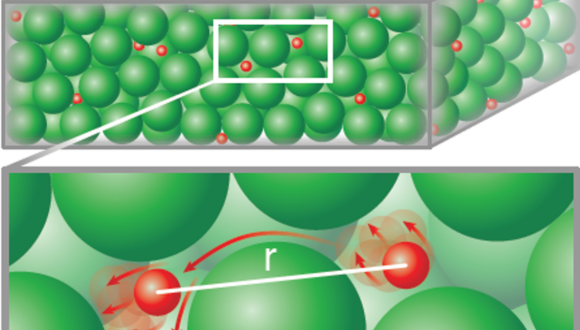
Colloidal Glass

Clear signatures of transformation

The researchers identified three clear signatures of the transition: a pronounced change in how the decay of correlations varies with distance; the emergence of a new characteristic length scale that grows with the material’s viscosity; and even opposing motions between neighboring particles — evidence of the development of resistance to shear, a fundamental property of solids. The experimental findings precisely confirmed theoretical predictions made by the same team several years ago.

Beyond glass: broader implications

The research team notes that, beyond their importance for a deeper understanding of the glass transition, the findings have broad implications. The new method may be used to study gels, soft materials, active systems, and even biological tissues — areas in which it is difficult to pinpoint when a system stops “flowing” and begins to solidify. In this sense, the tiny particles serve as microscopic witnesses to the moment a liquid loses its fluid character.

Prof. Haim Diamant concludes: “The significance of this research lies not only in identifying new signatures of the glass transition, but also in offering a fresh perspective on the phenomenon as a whole. Our findings show that the glass transition is not merely a gradual slowing of particle motion, but is accompanied by a profound change in the way momentum is transmitted from point to point within the material. The use of small tracer particles as hydrodynamic probes opens the possibility of examining the emergence of solid-like properties even before the system actually ceases to flow, and may provide a new tool for studying soft materials and complex systems in which the transition from liquid to solid is difficult to measure.”

The Electronics of the Future

TAU researchers develop ultra-efficient graphene switch at the nanometer scale

A team of researchers from Tel Aviv University, in collaboration with colleagues from Japan, has taken an important step toward the next generation of electronics. The scientists achieved highly precise control of the internal structure of graphene — an exceptionally thin and strong material — using a minute, nearly negligible amount of energy.

The study was conducted under the supervision of Prof. Moshe Ben-Shalom of the School of Physics and Astronomy, together with Prof. Michael Urbakh and Prof. Oded Hod of the School of Chemistry. The experiments and calculations were led by Dr. Nirmal Roy and Dr. Pengua Ying, supported by Simon Salleh Atri, Yoav Sharaby, Noam Raab, and Dr. Youngki Yao. The findings were published in the journal Nature Nanotechnology.

Why graphene stacking matters

Graphene, which consists of a thin layer of carbon atoms, has long been regarded as a “star” in the world of materials. Yet it is not only the material itself that matters, but also how the graphene layers are stacked on top of one another. Different stacking arrangements create entirely different properties: different electrical conductivity, different responses to magnetic fields, and even conditions that enable the emergence of superconductivity.

Until now, controlled switching between these stacking arrangements has been a complex process that required a great deal of energy and was unsuitable for practical applications. In the new study, the researchers succeeded in overcoming this obstacle.

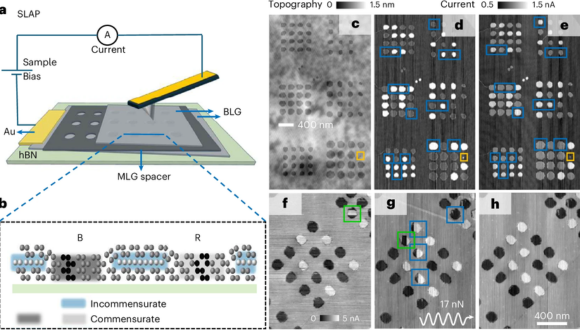
The solution they developed is based on an elegant concept: creating tiny “islands” of graphene — only tens of nanometers in diameter — where the layers remain in direct contact with one another, while the surrounding areas are separated by a layer that allows nearly frictionless sliding. Within these islands, one graphene layer can be shifted relative to another, thereby changing the stacking arrangement.

A striking result: structural change with minimal force

The result is striking: the material’s state can be changed using an extremely small force, with an energy input orders of magnitude lower than that required by existing memory technologies. In many cases, once the change is initiated, it continues on its own, without the need to apply additional force.


 An illustration of the research: The Super-Lubric Array of Polytypes (SLAP) device in action. The bright and dark circles represent high and low electrical currents.

Toward brain-inspired computing

Beyond this, the researchers showed that neighboring islands can be connected so that a structural change in one island also affects its neighbors. This opens the door to creating systems in which different regions “communicate” with one another in a mechanical-elastic manner, similar to a neural network. Such a property may be particularly relevant to the development of neuromorphic computing — computers that mimic the way the brain operates.

According to the researchers, the new method opens promising avenues for the development of memory components, sensors, and tiny electronic devices that are both fast and exceptionally energy-efficient. In the future, it may enable the creation of smart electronic systems on the nanometer scale — systems that consume less energy, generate less heat, and can perform complex operations in ways that until now seemed purely theoretical.

Prof. Moshe Ben-Shalom concludes: “This is a breakthrough that has the potential to transform the way electronic components are designed at the nanometer scale. We show that it is possible to control the structure of graphene and other layered crystals in a precise, reversible, and extremely energy-efficient manner. Instead of breaking and rebuilding chemical bonds, we simply slide atomic layers over one another — a natural process that is much faster and more efficient. The ability to design interactions between different regions within a material opens up new possibilities, not only for advanced electronics but also for brain-inspired computing systems. This is another step toward turning physical phenomena that until now were considered purely academic into practical, working technology.”


TAU Scientist Featured on Nobel Prize Prediction List

Prof. Rafi Bistritzer, an award-winning physicist, made the prestigious citation list.

Every year, Clarivate, the organization behind the Web of Science database, attempts to predict the next Nobel laureates in science. Their success rate is quite impressive, having accurately predicted 75 winners in the past through in-depth analysis of top researchers’ publications and citations.

This year’s list features 22 exceptional scientists who have made significant contributions across fields such as physiology, physics, chemistry and economics. Among them is Prof. Rafi Bistritzer from Tel Aviv University’s School of Physics and Astronomy, a scientist already globally recognized for his work in theoretical physics.

Prof. Bistritzer specializes in the theoretical study of complex two-dimensional materials formed by layering thin sheets on top of each other. In bilayer graphene, he demonstrated that a twist angle of 1.1 degrees, known as the “magic angle”, causes electrons to slow down and nearly stop, fundamentally altering the material’s electronic properties. This discovery marked the beginning of a new field called “twistronics”, a groundbreaking area with the potential for new scientific insights and exciting technological developments.

This recognition underscores the potential for a future Nobel Prize nomination and highlights the broad impact of Prof. Bistritzer’s research on our understanding of materials and physics. In 2020, Prof. Bistritzer, along with Prof. Allan H. MacDonald from the University of Texas and Prof. Pablo Jarillo-Herrero from MIT, was awarded the prestigious Wolf Prize for their achievements in this field.

Victoria

Phone: +61 3 9296 2065
Email: office@aftau.asn.au

New South Wales

Phone: +61 02 7241 8711
Email: admin@aftau.org.au

Western Australia

Phone: :+61 0418 46 5556
Email: davidsolomon@aftau.org.au