

How a Brain Parasite Becomes a Brain Cure
TAU research paves the way to brain healing with parasites
Have you ever imagined that parasites could be beneficial for brain diseases? TAU Researchers have reengineered Toxoplasma gondii, the ‘cat parasite,’ transforming it from a feared threat into a groundbreaking tool for delivering drugs directly to the brain. This surprising innovation not only overturns our expectations but also opens new possibilities for treating neurological disorders.
In a breakthrough study by an international team of scientists led by researchers from Tel Aviv and Glasgow Universities, the ‘cat parasite’ Toxoplasma gondii was engineered to deliver drugs to the human brain. The study was led by Prof. Oded Rechavi from the Department of Neurobiology and the Sagol School of Neuroscience at Tel Aviv University, together with his PhD student Dr. Shahar Bracha, and with Prof. Lilach Sheiner, an Israeli scientist and toxoplasma expert from the University of Glasgow in Scotland. The results were published in the leading scientific journal Nature Microbiology.
“One of the biggest challenges in treating neurological diseases is getting through the blood-brain barrier (BBB),” explains Prof. Rechavi. “It is tough to deliver drugs to the brain via the bloodstream, and this is especially true for large molecules such as proteins, the critical ‘machines’ that carry out many important functions inside the cell”.
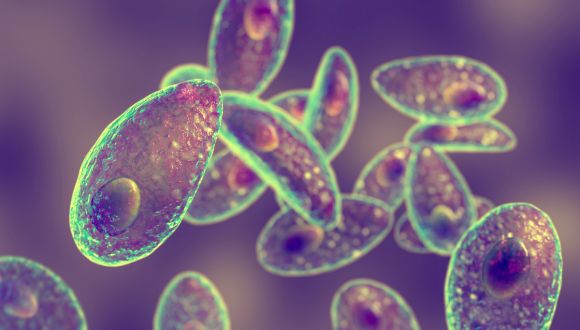
Toxoplasma gondii – the ‘cat parasite’
The creative solution proposed by the TAU team utilizes the unicellular parasite Toxoplasma gondii, which can infect a vast variety of organisms, but reproduces only in the guts of cats. The parasite is very effective in infecting humans, with an estimated third of the global population infected at some point in their lives. Prof. Rechavi explains: “Most people don’t even feel the infection or only experience mild flu-like symptoms.
Dormant Parasite Sparks New Treatment
The parasite is, however, dangerous for people with immune failure due to conditions like AIDS, and for fetuses whose immune system has not yet developed. This is why pregnant women are advised not to eat raw meat which might contain the parasite, and to stay away from cats, which might deliver it through their feces. While ridding the body of the parasite, a healthy immune system has only limited access to the brain, and the parasite remains in the brain throughout the carrier’s lifetime”.
The parasite’s ability to penetrate the human brain and survive there in a dormant state, without reproducing, made it a perfect candidate for the researchers’ novel approach: genetically engineering Toxoplasma gondii to secrete therapeutic proteins.
Can Parasites Deliver Medications to the Brain?
“The parasite has three distinct secretion systems and we ‘hitched a ride’ on two of them”, says Prof. Rechavi. “We did not intervene with the first system, which secretes proteins outside the neurons. The second system ‘shoots’ a ‘harpoon’ into the neuron, to enable penetration. Once inside, the parasite forms a kind of cyst that continues to secrete proteins permanently. We engineered the parasite’s DNA to make it produce and secrete the proteins we want, which have therapeutic potential”.
“The parasite’s ability to pass through the BBB and communicate with the neurons, combined with our ability to engineer the parasite, generate a golden opportunity for solving the great therapeutic challenge of delivering medications to the brain”, says Prof. Sheiner.
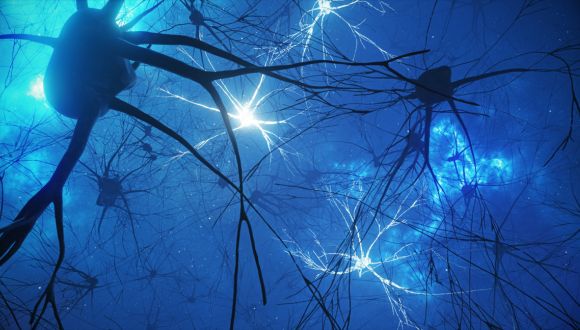
Illustration of the activity of neurons
In this study, the team used transgenic model animals that were injected with parasites genetically engineered to produce and secrete proteins that travel into cell nuclei. Several lines of evidence proved that the proteins had been delivered to the target area and remained active in the neurons’ nuclei. One of these was especially eye-catching: a protein that, delivered by the parasite, entered the nuclei and cut out specific DNA segments, causing the transgenic animals’ brains to glow in the dark.
New Method for Rett Syndrome
This breakthrough can have far-reaching implications for a series of severe diseases. In the present study, the researchers specifically demonstrated the delivery of a protein called MeCP2, whose deficiency is associated with Rett syndrome. “This is a deadly syndrome caused by a deficiency in a single gene called MePC2 in brain cells, and our engineered Toxoplasma gondii was able to deliver it to the target cells”, says Prof. Rechavi. “But this is just one example. There are many other diseases caused by deficiency or abnormal expression of a certain protein”. To ensure the method’s safe and effective therapeutic implementation, for both drug delivery and genetic editing, a company named Epeius was established in collaboration with Ramot – the technology transfer company of Tel Aviv University, and with the University of Glasgow’s research and innovation services.



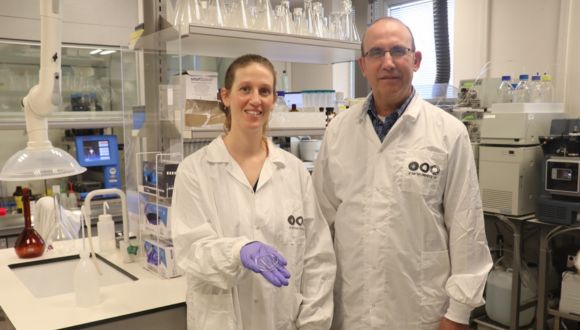


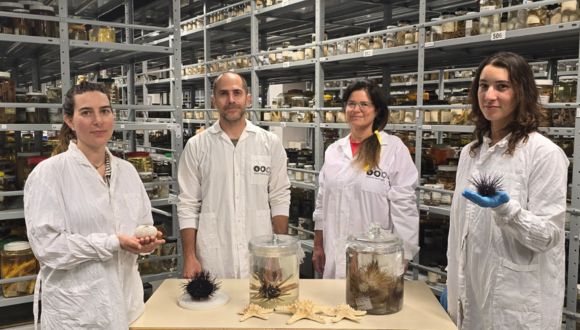


 Left to right – Prof. Jonathan Belmaker and Shahar Chaikin


 Chaviva Sirote-Katz
Despite the theoretical interest, there is a limitation in measuring these phenomena in quantum systems. Due to the nature of quantum mechanics, one cannot directly measure the electron’s wave function and its dynamical evolution. Instead, researchers indirectly measure the wave-like and topological properties of electrons in materials, for instance by measuring the electrical conductivity at the edges of solids.
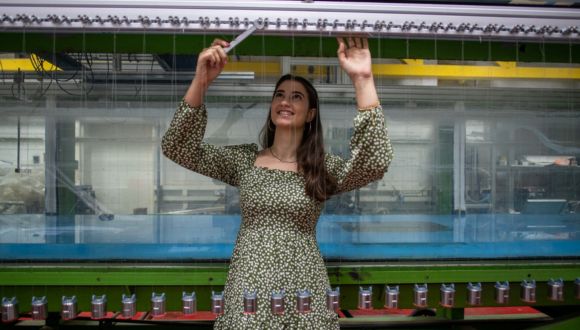
In the current study, the researchers considered the possibility of constructing a sufficiently large mechanical system that would adhere to dynamical rules akin to those found in quantum systems, and in which they could directly measure everything. To this end, they built an array of 50 pendula, with string lengths that slightly varied from one pendulum to the other. The strings of each neighboring pair of pendula were connected at a controlled height, such that each one’s motion would affect its neighbors’ motion.
Quantum Pendulum Insights
On one hand, the system obeyed Newton’s laws of motion, which govern the physics of our everyday lives, but the precise lengths of the pendula and the connections between them created a magical phenomenon: Newton’s laws caused the wave of the pendulum’s motion to approximately obey Schrödinger’s equation – the fundamental equation of quantum mechanics, which governs the motion of electrons in atoms and in solids. Therefore, the motion of the pendula, which is visible in the macroscopic world, reproduced the behaviors of electrons in periodic systems such as crystals.
The researchers pushed a few pendula and then released them. This generated a wave that propagated freely along the chain of pendula, and the researchers could directly measure the evolution of this wave – an impossible mission for the motion of electrons. This enabled the direct measurement of three phenomena. The first phenomenon, known as Bloch oscillations, occurs when electrons within a crystal are influenced by an electric voltage, pulling them in a specific direction. In contrast to what one would expect, the electrons do not simply move along the direction of the field, but they oscillate back and forth due to the periodic structure of the crystal. This phenomenon is predicted to appear in ultra-clean solids, which are very hard to find in nature. In the pendula system, the wave periodically moved back and forth, exactly according to Bloch’s prediction.
The second phenomenon that was directly measured in the pendula system is called Zener tunneling. Tunneling is a unique quantum phenomenon, which allows particles to pass through barriers, in contrast to classical intuition. For Zener tunneling, this appears as the splitting of a wave, the two parts of which then move in opposite directions. One part of the wave returns as in Bloch oscillations, while the other part “tunnels” through a forbidden state and proceeds in its propagation. This splitting, and specifically its connection to the motion of the wave in either direction, is a clear characteristic of the Schrödinger equation.
In fact, such a phenomenon is what disturbed Schrödinger, and is the main reason for the suggestion of his famous paradox; according to Schrödinger’s equation, the wave of an entire cat can split between a live-cat state and a dead-cat state. The researchers analyzed the pendula motion and extracted the parameters of the dynamics, for instance, the ratio between the amplitudes of the two parts of the split wave, which is equivalent to the quantum Zener tunneling probability. The experimental results showed fantastic agreement with the predictions of Schrödinger’s equation.
The pendula system is governed by classical physics. Therefore, it cannot mimic the full richness of quantum systems. For instance, in quantum systems, the measurement can influence the system’s behavior (and cause Schrödinger’s cat to eventually be dead or alive when it is viewed). In the classical system of macroscopic pendulum, there is no counterpart to this phenomenon. However, even with these limitations, the pendula array allows the observation of interesting and non-trivial properties of quantum systems, which may not be directly measured in the latter.
Chaviva Sirote-Katz
Despite the theoretical interest, there is a limitation in measuring these phenomena in quantum systems. Due to the nature of quantum mechanics, one cannot directly measure the electron’s wave function and its dynamical evolution. Instead, researchers indirectly measure the wave-like and topological properties of electrons in materials, for instance by measuring the electrical conductivity at the edges of solids.
In the current study, the researchers considered the possibility of constructing a sufficiently large mechanical system that would adhere to dynamical rules akin to those found in quantum systems, and in which they could directly measure everything. To this end, they built an array of 50 pendula, with string lengths that slightly varied from one pendulum to the other. The strings of each neighboring pair of pendula were connected at a controlled height, such that each one’s motion would affect its neighbors’ motion.
Quantum Pendulum Insights
On one hand, the system obeyed Newton’s laws of motion, which govern the physics of our everyday lives, but the precise lengths of the pendula and the connections between them created a magical phenomenon: Newton’s laws caused the wave of the pendulum’s motion to approximately obey Schrödinger’s equation – the fundamental equation of quantum mechanics, which governs the motion of electrons in atoms and in solids. Therefore, the motion of the pendula, which is visible in the macroscopic world, reproduced the behaviors of electrons in periodic systems such as crystals.
The researchers pushed a few pendula and then released them. This generated a wave that propagated freely along the chain of pendula, and the researchers could directly measure the evolution of this wave – an impossible mission for the motion of electrons. This enabled the direct measurement of three phenomena. The first phenomenon, known as Bloch oscillations, occurs when electrons within a crystal are influenced by an electric voltage, pulling them in a specific direction. In contrast to what one would expect, the electrons do not simply move along the direction of the field, but they oscillate back and forth due to the periodic structure of the crystal. This phenomenon is predicted to appear in ultra-clean solids, which are very hard to find in nature. In the pendula system, the wave periodically moved back and forth, exactly according to Bloch’s prediction.
The second phenomenon that was directly measured in the pendula system is called Zener tunneling. Tunneling is a unique quantum phenomenon, which allows particles to pass through barriers, in contrast to classical intuition. For Zener tunneling, this appears as the splitting of a wave, the two parts of which then move in opposite directions. One part of the wave returns as in Bloch oscillations, while the other part “tunnels” through a forbidden state and proceeds in its propagation. This splitting, and specifically its connection to the motion of the wave in either direction, is a clear characteristic of the Schrödinger equation.
In fact, such a phenomenon is what disturbed Schrödinger, and is the main reason for the suggestion of his famous paradox; according to Schrödinger’s equation, the wave of an entire cat can split between a live-cat state and a dead-cat state. The researchers analyzed the pendula motion and extracted the parameters of the dynamics, for instance, the ratio between the amplitudes of the two parts of the split wave, which is equivalent to the quantum Zener tunneling probability. The experimental results showed fantastic agreement with the predictions of Schrödinger’s equation.
The pendula system is governed by classical physics. Therefore, it cannot mimic the full richness of quantum systems. For instance, in quantum systems, the measurement can influence the system’s behavior (and cause Schrödinger’s cat to eventually be dead or alive when it is viewed). In the classical system of macroscopic pendulum, there is no counterpart to this phenomenon. However, even with these limitations, the pendula array allows the observation of interesting and non-trivial properties of quantum systems, which may not be directly measured in the latter.
 The third phenomenon that was directly observed in the pendula experiment was the wave evolution in a topological medium. Here, the researchers found a way to directly measure the topological characteristic from the wave dynamics in the system – a task that is almost impossible in quantum materials. To this end, the pendula array was tuned twice, so that they would mimic Schrödinger’s equation of the electrons, once in a topological state and once in a trivial (i.e. standard) state. By comparing small differences in the pendulum motion between the two experiments, the researchers could classify the two states. The classification required a very delicate measurement of a difference between the two experiments of exactly half a period of oscillation of a single pendulum after 400 full oscillations that lasted 12 minutes. This small difference was found to be consistent with the theoretical prediction.
The experiment opens the door to realizing further situations that are even more interesting and complex, like the effects of noise and impurities, or how energy leakage affects wave dynamics in Schrödinger’s equation. These are effects that can be easily realized and seen in this system, by deliberately perturbing the pendula motion in a controlled manner.
The third phenomenon that was directly observed in the pendula experiment was the wave evolution in a topological medium. Here, the researchers found a way to directly measure the topological characteristic from the wave dynamics in the system – a task that is almost impossible in quantum materials. To this end, the pendula array was tuned twice, so that they would mimic Schrödinger’s equation of the electrons, once in a topological state and once in a trivial (i.e. standard) state. By comparing small differences in the pendulum motion between the two experiments, the researchers could classify the two states. The classification required a very delicate measurement of a difference between the two experiments of exactly half a period of oscillation of a single pendulum after 400 full oscillations that lasted 12 minutes. This small difference was found to be consistent with the theoretical prediction.
The experiment opens the door to realizing further situations that are even more interesting and complex, like the effects of noise and impurities, or how energy leakage affects wave dynamics in Schrödinger’s equation. These are effects that can be easily realized and seen in this system, by deliberately perturbing the pendula motion in a controlled manner.

 A prinia bird leaninn on a branch.
The research was conducted under the leadership of research student Congnan Sun, Dr. Arjan Boonman and Prof. Yossi Yovel, head of
A prinia bird leaninn on a branch.
The research was conducted under the leadership of research student Congnan Sun, Dr. Arjan Boonman and Prof. Yossi Yovel, head of  In total, the researchers recorded 3,234 hours containing around 250,000 bird calls, using artificial intelligence to identify the calls and the birds that made them. During the lockdown, human activity in the residential areas increased by 49% and human activity in the Yarkon Park – while leaving homes to go to parks was still prohibited – decreased by 31%.
“First, we found that the overall activity of the birds, regardless of COVID-19, is 53% higher in the parks than in the streets adjacent to them”, explains Prof. Yuval. “The parks are a center of activity for birds, and that is always true. On the other hand, a complex picture emerges from the lockdown period. The crows and ringneck parakeets, which usually subsist on leftover food from people in the park, searched for other avenues. The calls from the crows in the park decreased by about 50%, and the chirping of the ringneck parakeets in the park dropped by around 90%. Conversely, the shy graceful prinia, an outstanding adaptor, increased its activity by about 12%. These findings highlight the fact that there are animals that depend on us in the city, as well as the flexibility of these animals and the complexity and diversity of the urban ecosystem”.
In total, the researchers recorded 3,234 hours containing around 250,000 bird calls, using artificial intelligence to identify the calls and the birds that made them. During the lockdown, human activity in the residential areas increased by 49% and human activity in the Yarkon Park – while leaving homes to go to parks was still prohibited – decreased by 31%.
“First, we found that the overall activity of the birds, regardless of COVID-19, is 53% higher in the parks than in the streets adjacent to them”, explains Prof. Yuval. “The parks are a center of activity for birds, and that is always true. On the other hand, a complex picture emerges from the lockdown period. The crows and ringneck parakeets, which usually subsist on leftover food from people in the park, searched for other avenues. The calls from the crows in the park decreased by about 50%, and the chirping of the ringneck parakeets in the park dropped by around 90%. Conversely, the shy graceful prinia, an outstanding adaptor, increased its activity by about 12%. These findings highlight the fact that there are animals that depend on us in the city, as well as the flexibility of these animals and the complexity and diversity of the urban ecosystem”.


