Tag: Archeology

Why Did Early Humans Stop Using Massive Stone Tools?

New TAU study suggests the answer lies not in human intelligence alone but in the disappearance of giant animals

A new study by Tel Aviv University researchers offers a novel explanation for a longstanding mystery in prehistoric research: why the heavy-duty stone tools used by early humans for more than a million years disappeared and were replaced by smaller, more refined tools. According to the study, published in the journal Quaternary Science Reviews, this shift was not driven solely by cognitive development that enabled technological progress, but rather by changes in the composition of  mammal populations living in the region — most notably the disappearance of animals weighing over a ton (megaherbivores) such as prehistoric elephants, hippopotamuses, and rhinoceroses, on which humans depended for survival.

The study was led by doctoral student Vlad Litov, Dr. Miki Ben-Dor, and Prof. Ran Barkai of Tel Aviv University’s Alkow Department of Archaeology, Entin Faculty of Humanities. Prof. Barkai is a leading authority on ancient Paleolithic cultures. The findings were published in the academic journal Quaternary Science Reviews.

From Giant Animals to Smaller Prey

Vlad Litov: “During the Lower Paleolithic period (approximately 2 million to 200,000 years ago), humans routinely used heavy-duty tools such as handaxes, cleavers, and massive scrapers. These tools were particularly well suited for butchering and processing the very large animals that served as a primary food source for humans throughout this period. However, with the transition to the Middle Paleolithic period, around 200,000 years ago, heavy-duty tools almost completely disappeared and were replaced by smaller, lighter, and more sophisticated tools. Until now, this shift has been attributed to advances in human cognition. In our new study, we propose a different interpretation: the dramatic decline in the prevalence of megaherbivores was the key driver of this technological change.”
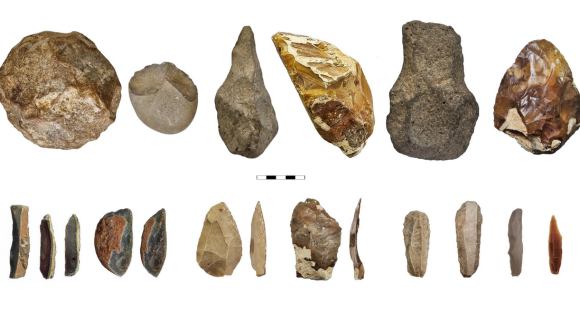
Prehistoric Stone Tool Types

The researchers analyzed dozens of archaeological sites in the Levant and compared the types of tools with the composition of the animal remains found at the sites. The findings show that in earlier periods, large animals dominated both in biomass and in species prevalence and diversity, while in later periods their presence sharply declined, alongside an increase in the hunting of small and medium-sized animals.

According to the researchers, heavy-duty tools were essential for high-intensity tasks such as butchering large animals and breaking bones in order to extract substantial quantities of meat and marrow. As these animals disappeared, the need for these types of tools diminished, and humans shifted to lighter, smaller tools better suited to processing smaller prey. In the absence of large game, early hunters were forced to target greater numbers of smaller mammals, such as fallow deer, which yielded less meat and fat. The smaller tools enabled more efficient processing of large quantities of smaller animals, while the heavy-duty tools, such as the handaxe, lost their functional relevance.

Environmental Change May Have Driven Human Evolution

The researchers note that the study offers a broader perspective on human evolution: technology is shaped not only by cognitive abilities, but also by environmental conditions and the animals that coexisted with humans. In fact, environmental changes may have driven cognitive and technological development — and not the other way around.

Prof. Barkai concludes: “The findings shed new light on the relationship between early humans and their environment, highlighting how profound ecological changes can shape human culture, technology, and ways of life over time. Our study suggests that the dramatic technological shifts of prehistory were not the result of a sudden leap in human cognitive abilities, but rather a direct response to major environmental change. As the megaherbivores — a key source of food — gradually diminished, humans were forced to adapt to a new reality of hunting and processing smaller prey. The transition to lighter, more precise tools reflects this adaptation. In this sense, the environment not only influenced early humans, but directly shaped their technology, and perhaps even their cultural and cognitive development.”

 

World-Scale Discovery in Northern Israel Reveals Early Humans’ Sense of Aesthetics

Rare archaeological findings in the Sakhnin Valley suggest that Homo erectus attributed meaning and visual significance to natural features hundreds of thousands of years ago

A Tel Aviv University Archaeologist and a resident of the Arab city of Sakhnin recently led an exceptional archaeological discovery in Lower Galilee Sakhnin Valley, shedding new light on the cultural and cognitive world of our early ancestors. A surface survey revealed a series of Paleolithic sites containing hundreds of handaxes — large, carefully crafted stone tools — identified with Homo erectus, the early human species that lived in the region hundreds of thousands of years ago.

Beyond the impressive quantity, however, the most noteworthy and unique find is an unprecedented concentration of handaxes shaped deliberately around fossils and distinctive geological features — a phenomenon almost unknown from other sites around the world. The study appeared in the prestigious journal published by the Sonia & Marco Nadler Institute of Archaeology, Entin Faculty of Humanities: Tel Aviv: Journal of the Institute of Archaeology of Tel Aviv University.

A Discovery That Began in the Field

The sites in the Sakhnin Valley were identified by Muataz Shalata, a self-taught nature enthusiast from the city of Sakhnin, who noticed unusual knapped stones scattered across the terrain.  He contacted Prof. Ran Barkai of the Elkov Department of Archaeology at Tel Aviv University, an expert in the study of early Paleolithic cultures. Together, they are leading an innovative study focusing on human behaviors that evolved in the Sakhnin Valley hundreds of thousands of years ago.

A Hub of Human Activity

Prof. Barkai: “Handaxes served as the main tool of early humans for more than a million years, and are known from Africa, Asia, and Europe. In the Sakhnin Valley, many hundreds of handaxes were found, indicating that the area served as an important hub of human activity over long periods of time. Providing early humans with all their needs – water sources, game, and an exceptional abundance of high-quality flint nodules — the area probably attracted human groups repeatedly over hundreds of thousands of years”.

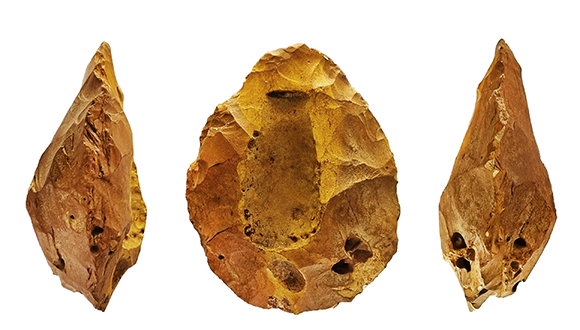
“The Valley is also very rich in geodes – rounded, brain-like geological concretions containing sparkling crystals, as well as flint nodules embedded with fossil remains. Early humans who came here hundreds of thousands of years ago must have been astonished by this exceptional richness of stones, leaving behind them an extraordinary phenomenon: we have discovered more than ten handaxes fashioned from flint nodules containing fossils or special geological formations, with these natural features deliberately preserved in a prominent position at the center of each handaxe. Since such features make precise and symmetrical knapping difficult, we can conclude that the selection of these specific stones was not accidental. On the contrary — the knapping process highlighted the natural feature and kept it at the center of the tool.”


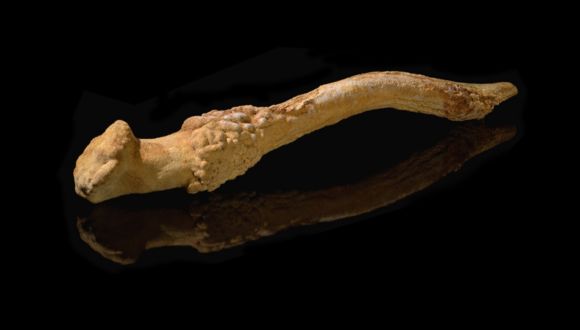
A handaxe shaped around the imprint of a fossil from the Sakhnin Valley

Beyond Survival: Early Signs of Aesthetic Thinking

According to the researchers, this unique phenomenon clearly demonstrates aesthetic and conceptual intention among early humans, beyond functional considerations of tool production. Embedded fossils and geological formations do not improve the tool’s performance and may even impair it, yet such stones were repeatedly preferred as raw material. The conscious choice to invest effort in shaping a tool around an exceptional natural feature indicates that beyond survival needs, humans attributed special value to the stones’ appearance and meaning. Knapping served as a means for framing, highlighting, and enhancing intriguing natural phenomena, reflecting advanced perceptual and cognitive abilities.

The researchers also note that the Sakhnin Valley is located near presumed routes of early elephants, which were a primary food source for humans during this period. Thus, as at other prehistoric sites such as Gesher Bnot Ya‘akov, the handaxes were probably used to cut up elephants and extract calories from their fat and meat. However, such a high concentration of special handaxes is unknown in any other site worldwide, exceeding all comparable finds documented to date.

Prof. Barkai concludes: “The unique landscape of the Sakhnin Valley led early humans to behave in a distinctive manner. Apparently, they attributed great significance to the fossils and special geological features they found in the Valley, regarding them as manifestations of the potency, primordiality, and wonder of the cosmos. The integration of fossils and geological features endowed the handaxes with added potency and meaning, connecting them primeval elements. The findings from the Sakhnin Valley open a rare window into the inner world of early humans, indicating that already at the dawn of human history they were sensitive to aesthetics, attributed meaning to nature, and had complex relationships with their world. The discovery places the Sakhnin Valley and the Lower Galilee at the heart of the international scholarly discussion on the origins of cognition, aesthetics and meaning in human life.”

* Prof. Ran Barkai is a prehistoric archaeologist at Tel Aviv University, specializing in the study of early human evolution and cultures. He is known, among other things, for his excavations at Qesem Cave and his research on the links between diet, animals, and the development of human consciousness.

Cosmic Particles Help Archaeologists Detect Hidden Underground Spaces

TAU study demonstrates how muon detectors can be used to map subterranean voids before excavation, offering archaeologists a powerful new tool.

A technological breakthrough at Tel Aviv University offers archaeologists a way to identify underground spaces before digging. The system detects muons — elementary particles generated when cosmic rays hit Earth’s atmosphere — which can penetrate rock and soil up to 100 meters deep. By tracking their paths, researchers can locate hidden voids such as tunnels and cisterns.

The method was successfully demonstrated at the City of David archaeological site in Jerusalem, where the system mapped Jeremiah’s Cistern by identifying changes in soil permeability to muons.

Combining Physics and Archaeology

The study was led by Prof. Erez Etzion from TAU’s Raymond and Beverly Sackler School of Physics and Astronomy, and Prof. Oded Lipschits from TAU’s Jacob M. Alkow Department of Archaeology and Ancient Near Eastern Cultures. Other participants included: Prof. Yuval Gadot from the Department of Archaeology and Ancient Near Eastern Cultures; Prof. Yan Benhammou, Dr. Igor Zolkin, and doctoral student Gilad Mizrachi from the School of Physics and Astronomy; Dr. Yiftah Silver and Dr. Amir Weissbein of Rafael Advanced Defense Systems; and Dr. Yiftah Shalev of the Israel Antiquities Authority. The study’s results were published in the Journal of Applied Physics.

“From the pyramids in Egypt, through the Maya cities in South America, to ancient sites in Israel, archaeologists struggle to discover underground spaces,” explains  Prof. Lipschits. “Above-ground structures are relatively easy to excavate, and there are also various methods for identifying walls and structures below the surface. However, there are no effective methods for conducting comprehensive surveys of subterranean spaces beneath the rock on which the ancient site is situated. In the Judean Foothills, for example, the top layer of hard limestone overlies soft chalk, in which the ancients easily carved out vast spaces for water reservoirs, agricultural uses, storage, or even dwellings. Clearly, in such regions, most above-ground archaeological sites resemble Swiss cheese beneath the rock, but we have no way of knowing this. If by chance we excavate above ground, reach the rock, and identify an entrance to a cavity, we could excavate it, but we have no way of locating the subterranean spaces in advance. In the current study, we propose for the first time an innovative method that has been proven very effective in detecting underground spaces with detectors of cosmic radiation, specifically muons.”

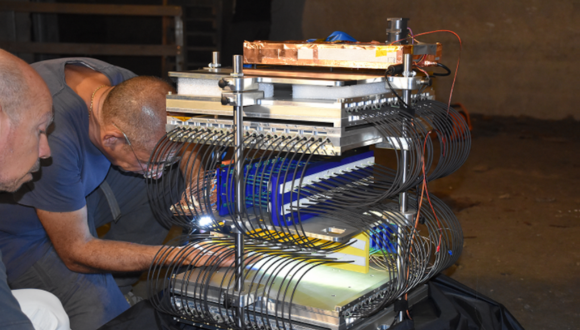
A team from TAU is installing the muon detectors in Jeremiah’s Cave beneath the City of David site

How Muon Imaging Works

The researchers explain that a muon is an elementary particle similar to an electron but 207 times more massive. Muons are created in the atmosphere when energetic particles, mainly protons, collide with the nuclei of molecules in the air. This collision generates unstable particles called pions, which decay very quickly into muons. Muons also have a very short lifetime, decaying after 2.2 microseconds, but they move at speeds close to the speed of light, and thanks to Einstein’s special relativity theory, many of them manage to reach and penetrate the ground.

“The muon shower hits the ground at a fixed and known rate,” explains Prof. Etzion. “Unlike electrons, which are stopped by the ground at just a few centimeters deep, muons lose energy slowly as they pass through the ground, and some can penetrate much deeper – even up to 100 meters for highly energetic particles. Therefore, by placing muon detectors underground and monitoring the environment, we can identify empty cavities where energy loss is minimal. This process is similar to X-ray imaging: the X-ray beam is stopped by bones but passes through soft tissue like flesh or fat, and a camera on the other side captures the resulting image. In our case, the muons act as the X-ray beam, our detector is the camera, and the underground features are the human body.”

Next Steps

As noted, the researchers conducted an impressive demonstration in a rock-hewn installation known as Jeremiah’s Cistern at the archaeological site of the City of David. Combining a high-resolution LiDAR scan of the interior cavity with simulations of the muon flux, they were able to map structural anomalies. Detecting changes in soil penetrability to muons, the system demonstrated the feasibility of using muon tomography for archaeological imaging.

“This article is a first milestone,” says Prof. Lipschits. “We ask physicists to respond to the archaeological need and develop smaller, simpler, cheaper, more durable, more accurate, and more power-efficient detectors. In the next stage, we intend to combine physics and archaeology with AI to produce a 3D image of the subsurface from the vast data generated by the detectors. Our test site will be Tel Azekah in the heart of the Judean Foothills, overlooking the Elah Valley.”

“This is not our invention,” adds Prof. Etzion. “Already in the 1960s, muons were used to search for hidden chambers in the pyramids in Egypt, and recently the technology was revived. Our innovation lies in developing small and mobile detectors and learning how to operate them at archaeological sites. After all, there is a difference between a detector in laboratory conditions and a detector that must be taken to a cave or excavation, where practical problems of electricity, temperature, and humidity inevitably arise. Detection ranges depend on measuring time; the farther the detector’s location, the fewer particles reach it, but realistically, it is possible to analyze images from a distance of up to 30 meters within a reasonable timespan. Therefore, our goal is to place several detectors or move one detector from place to place to produce a 3D image of the entire site eventually. And we have just begun. The next stage involves sophisticated analysis, which will allow us to map everything beneath our feet – even before the excavation begins.”

Dramatic Discovery at Tel Aviv University: 15th-Century Holy Books of Ethiopian Jewry—the Oldest Found to Date

Two Orit books (the Torah of Beta Israel – Ethiopian Jewry) from the 15th century were discovered by the Orit Guardians program of TAU’s Department of Biblical Studies.

A Rare Discovery:  A traveling workshop of TAU’s Orit Guardians program discovered two 15th-century Orit books – the oldest found to date in the possession of Beta Israel. The Orit Guardians Master’s program was established about five years ago, with the primary goal of studying, preserving, and carrying on the Biblical heritage of Ethiopian Jewry. The workshop was held in collaboration with the Ethiopian Jewry Heritage Center and the National Library of Israel, which documented the books and established the Digital Archive of Beta Israel’s Scriptures. Recently, these books were exposed at a special event held at ANU – Museum of the Jewish People, led by the Koret Center for Jewish Civilization (a collaboration between ANU and TAU), which supports and advances the Orit Guardians program.

The program’s initiator, Prof. Dalit Rom-Shiloni from the Department of Biblical Studies, Chaim Rosenberg School of Jewish Studies and Archaeology, explains: “The Orit of Beta Israel includes the Five Books of the Torah, as well as the Books of Joshua, Judges, and Ruth. So far, we have documented four Orit books, including the two from the 15th century, as well as 13 other sacred books. All the sacred books of Ethiopian Jewry are written in Ge’ez, a language known only to the Kessim, and each manuscript has its own fascinating story. They have been passed down through generations from father to son, and some were given to Kessim by their teachers — Jewish monks who taught the sacred traditions in Ethiopia. The books were carefully guarded and preserved, with some of their owners even risking their lives to bring them to Israel. Today, most of these books are privately owned by Kessim and their families and used as “living books” in the prayer houses of Ethiopian Jewish communities across Israel. Until now, they were inaccessible to interested individuals of the general public, nor to the research world, and we intend to locate as many books as possible for preservation, digitization, and academic study.”

To this end, a unique traveling workshop was held in June 2024, with participants including: Prof. Rom-Shiloni, anthropologist Prof. Erica Weiss, linguist Dr. Anbessa Teferra, and students from the Orit Guardians program — all from Tel Aviv University, alongside representatives of the Ethiopian Jewry Heritage Center and the National Library, as well as three international experts in ancient Ethiopian sacred texts: Prof. Loren Stuckenbruck (Ludwig Maximilian University of Münich), Dr. Sophia Dege-Müller and Ted Erho (University of Hamburg). The international experts examined and dated the books using palaeography — based on script forms. To their astonishment, they found that two of the Orit books were written as early as the 15th century — the oldest discovered so far in the hands of Beta Israel. Prof. Rom-Shiloni explains: “Our discovery is causing a stir among experts in the field worldwide. While we are familiar with similar Ethiopian texts from this period or even earlier, all of those are Christian texts, not Jewish. Now, for the first time, it has been revealed that Kessim from Beta Israel possess Orit books that are over 600 years old.”

In total, the workshop yielded four Orit books — two from the 15th century and two from the 18th century, as well as 13 other sacred books from the 17th to 20th centuries. All the discovered books were documented with their owners’ consent and remain in their possession — so they can continue to serve as “living books” in their communities. The documentation now enables academic research and the establishment of a digital archive at the National Library.

Prof. Youval Rotman, Academic Director of the Koret Center and faculty member in the Department of Jewish History at Tel Aviv University, added: “This is an extraordinary finding. Discovering ancient manuscripts is rare, and when they are the oldest of their kind in existence, the find is all the more exceptional. This discovery was made thanks to the Orit Guardians’ emphasis on studying the textual knowledge and interpretive tradition preserved and orally transmitted over centuries within the various Beta Israel communities. The uniqueness of the program lies not only in mapping manuscripts and training students for their research but also in doing so as an integral part of the knowledge preserved within the community — thereby continuing and expanding it. The young researchers form personal connections and earn the trust of the Kessim as successors to the tradition and oral interpretation. In doing so, they connect communal-social knowledge to academic knowledge — and this is our great pride. The program unearths hidden treasures that have so far dwelt within the four walls of local synagogues, then documents and studies them and makes them accessible. Imagine a situation in which the great Bible commentaries were passed down orally through generations.”

Prof. Rom-Shiloni concludes: “Through the traveling workshop of the Orit Guardians program we discovered 17 sacred books of Beta Israel held by Kessim across Israel and still used as “living books” in the prayer houses of Ethiopian Jewry. Among them, we discovered two Orit books — the Torah of Beta Israel — written in the 15th century, the earliest found so far in the hands of Jewish Kessim.
Alongside the excitement, we believe our discovery is only the tip of the iceberg. It is likely that many more sacred books of Beta Israel are held by families and Kessim around the country, and we will continue searching for them. It is important to emphasize that all manuscripts located (like those found through the workshop) will remain in the possession of their owners, while being photographed and documented to make them accessible to interested members of the community, the broader public, and researchers in Israel and around the world. Another, especially urgent task of the Orit Guardians is documenting the scholarly oral traditions of the Kessim in Ethiopia, which includes translation from Ge’ez to Amharic and interpretation of the Orit and other holy books. This heritage, transmitted only orally from generation to generation, has never been set down in writing. Today, only 18 senior Kessim, who were trained in Ethiopia and hold this knowledge, remain active in Israel, and they are aging. If we do not act quickly, we might lose this precious cultural treasure.”


Stone Age BBQ: How Early Humans Preserved Meat with Fire

Did Early Humans Smoke Meat Million Years Ago?

Did prehistoric humans know that smoking meat could preserve it and extend its shelf life? Researchers from the Alkow Department of Archaeology and Ancient Near Eastern Cultures at Tel Aviv University believe they did. Their new study presents a fresh perspective on a question that has long preoccupied prehistory scholars: What prompted early humans to begin using fire? According to the researchers, early humans, who primarily consumed large game, required fire not for cooking, but to smoke and dry meat so that it would not rot, thereby preserving it for extended periods and keeping it safe from predators and scavengers.

Why Did Early Humans First Use Fire?

This insight fits into a broader unifying theory, developed by the same researchers, which explains many prehistoric phenomena based on human dependence on calories derived from large animals, alongside a continuous decline in the size of animals hunted throughout prehistoric periods. The study was conducted by Dr. Miki Ben-Dor and Prof. Ran Barkai of the Alkow Department of Archaeology and Ancient Near Eastern Cultures at Tel Aviv University and was published in the journal Frontiers in Nutrition.

Prof. Barkai explains: “The origins of fire use is a ‘burning’ topic among prehistory researchers around the world. It is generally agreed that by 400,000 years ago, fire use was common in domestic contexts—most likely for roasting meat, and perhaps also for lighting and heating. However there is controversy regarding the preceding million years, and various hypotheses have been put forward to explain why early humans began using fire. In this study, we sought to explore a new perspective on the issue”.

Dr. Ben-Dor adds: “For early humans, fire use was not a given, and at most archaeological sites dated earlier than 400,000 years ago, there is no evidence of the use of fire. Nevertheless, at several early sites, there are clear signs that fire was used, but without burnt bones or evidence of meat roasting. We understand that early humans at that time—mostly Homo erectus—did not use fire regularly, but only occasionally, in specific places and for special purposes. The process of gathering fuel, igniting a fire, and maintaining it over time required significant effort, and they needed a compelling, energy-efficient motive to do so. We have proposed a new hypothesis regarding that motive”.

Fire as a Shield Against Predators and Decay

The researchers reviewed the existing literature on all known prehistoric sites dated between 1.8 million and 800,000 years ago where evidence of fire use was found. There are nine such sites worldwide, including Gesher Benot Ya’aqov and Evron Quarry in Israel, six sites in Africa, and one site in Spain. Additionally, they relied on ethnographic studies of contemporary hunter-gatherer societies, aligning their behavior with the conditions that prevailed in ancient environments.

Dr. Ben-Dor: “We examined what the nine ancient sites had in common, and found that all contained large quantities of bones from large animals—mostly elephants, but also hippopotamuses, rhinoceroses, and others. From previous studies, we know that these animals were extremely important to early human diets and provided most of the necessary calories. The meat and fat of a single elephant, for example, contain millions of calories, enough to feed a group of 20–30 people for a month or more. A hunted elephant or hippopotamus was thus a real treasure—a kind of meat and fat ‘bank’ that needed to be protected and preserved for many days since it was coveted not only by predators but also by bacteria”.

An analysis of the findings and calculations of the significant energetic advantage of preserving meat and fat led the researchers to a new conclusion, never before proposed: fire served two vital purposes for early humans—first, to guard the large game from other predators and scavengers seeking to seize the ‘treasure’, and second, to preserve the meat through smoking and drying, preventing spoilage and making it edible for a long period.

Prof. Barkai concludes: “In this study, we propose a new understanding of the factors that motivated early humans to begin using fire: the need to safeguard large hunted animals from other predators, and to preserve the vast quantity of meat over time. It is likely that once the fire was produced for these purposes, it was also occasionally used for cooking—at zero marginal energetic cost. Such use may explain evidence of fish roasting from around 800,000 years ago at Gesher Benot Ya’aqov. The approach we propose fits well into a global theory we have been developing in recent years, which explains major prehistoric phenomena as adaptations to the hunting and consumption of large animals, followed by their gradual disappearance and the resulting need to derive adequate energy from exploiting smaller animals”.

Prof. Ran Barkai.

This Is Why Children Took Part in Creating Prehistoric Cave Art

TAU study suggests that children were seen as mediators between the physical and spiritual worlds.

 A team of Tel Aviv University researchers from prehistoric archaeology has proposed an innovative hypothesis regarding an intriguing question: Why did ancient humans bring their young children to cave painting sites, deep underground – through dark, meandering, hazardous passages? The researchers explain: “Next to many cave paintings, there is clear evidence of children as young as two. So far, most hypotheses have focused on the educational aspect — learning the community’s traditions and customs. However, we believe that children also played a unique cultural role in these caves: Young children were credited with special qualities in the spiritual world, enabling them to communicate with entities from the beyond – which were believed to be accessible from the depths of the cave”.

The study was conducted by Dr. Ella Assaf, Dr. Yafit Kedar, and Prof. Ran Barkai from the Jacob M. Alkow Department of Archaeology and Ancient Near Eastern Cultures at Tel Aviv University. The paper was published in the journal Arts from MDPI.

Dr. Ella Assaf.

Children’s Role in Cave Art: More Than Just Education

Dr. Assaf explains: “Cave art created by early humans is a fascinating phenomenon that intrigues many researchers. To date, around 400 caves containing cave art have been discovered, mainly in France and Spain, with the artwork dated between 40,000 and 12,000 years ago. There is solid evidence of children’s participation in the artwork – handprints and finger paintings made by children aged two to twelve. In addition, footprints and handprints of children have been found in some caves, alongside those of adults. This naturally raises the question: Why were the children there? Why were young children taken on exhausting and hazardous journeys deep into the dark, meandering caves with low oxygen levels – crawling through crevices, descending shafts, and climbing rocks to reach their destination?

Finger paintings made by children in Rouffignac Cave, 14,000 to 20,000 years ago (Photo courtesy of Dr. Van Gelder).

Dr. Kedar elaborates: “Despite extensive research on cave art, few studies have focused on the presence of children. The prevailing hypothesis is that their participation served an educational purpose – passing down knowledge, traditions, and customs to the next generation. In our study, we argue that children’s involvement had an additional meaning: In fact, they played an important, unique role of their own – direct communication with entities residing in the depths of the earth and otherworldly realms. This study follows our previous works, in which we presented cave artworks as expressions of cosmological approaches, with emphasis on relationships between humans and various entities”.

Children as Mediators Between Worlds in Ancient Rituals

Dr. Assaf adds: “Based on extensive studies about children in indigenous societies, along with new insights into rituals performed in caves with cave paintings, a new understanding is emerging regarding the role of children in the creation of cave art. By integrating data from these research fields, we were able, for the first time, to propose a novel and original explanation for the inclusion of children in creating cave paintings:  The world of childhood differs from that of adults, and children possess a range of unique mental and cognitive traits. For this reason, indigenous cultures worldwide, throughout history and prehistory, have viewed children as ‘active agents’ – mediators between this world and the entities inhabiting the natural world, the underworld, and the cosmos as a whole. In this way, children made a vital contribution to their communities – hunter-gatherers who lived in nature and sought to maintain continuous, respectful relationships with various entities: animals and plants that served as food sources, stones used for toolmaking, ancestral spirits, and more”.

Children’s footprints from Basura Cave, 14,000 years ago (Photo courtesy of Prof. Marco Romano – Romano et al. 2019).

Prof. Barkai: “Many of these societies regarded caves as gateways to the underworld – where, through shamanic rituals, they could communicate with cosmic entities and inhabitants of the underworld, to resolve existential problems. In this context, young children were perceived as liminal beings – belonging to both the realm they had left just recently (before birth) and the world they currently inhabit. Thus, small children were considered particularly suited to bridging the gap between the worlds and delivering messages to non-human entities. In this paper, we connect these insights and propose that children joined adults on journeys into the depths of caves and participated in painting and rituals as part of their role in the community—as ideal mediators with entities from the beyond”.

Prof. Ran Barkai.

Why Is There No Cave Art in Israel’s Ancient Caves?

Research suggests: extinct animals explain Israel’s lack of cave art.

For over a century, archaeologists have puzzled over the absence of cave art in the Levant in general, and specifically in Israel. Clearly, the reason is not a lack of caves, knowledge, or artistic skill. Now, a team of archaeologists from Tel Aviv University proposes an original explanation: prehistoric humans in the Levant did not create cave paintings because many large animals, the subjects of cave art in Western Europe, were already extinct here – so there was no need to try to depict them for shamanic rituals held deep within caves.

The study was published in an editorial article of the Journal of the Israel Prehistoric Society, authored by a team of researchers from Tel Aviv University’s Jacob M. Alkow Department of Archaeology & Ancient Near Eastern Cultures: Prof. Ran Barkai, Dr. Ilan Dagoni, Dr. Miki Ben-Dor, and Dr. Yafit Kedar.

Prof. Ran Barkai.

The enigma of missing cave art in Israel

“This is a century-old mystery in Israeli archaeological research”, says Prof. Barkai. “The first prehistoric cave excavation in Israel took place in 1925, but frustratingly, not a single cave painting has been found since. In other parts of the world, such as Spain and France, hundreds of spectacular cave paintings have been discovered. Here, nothing. Israel certainly has caves, and many were inhabited by humans during the same period when cave paintings were created in Western Europe – 35,000 to 30,000 years ago. Moreover, according to all material evidence, the people in both regions belonged to the same culture – the Aurignacian culture. Their tools were similar, and their artistic objects, beads and pendants, for example, were also similar. There is no doubt that humans here had the cognitive ability to paint and were no less capable than their European contemporaries”. The mystery around the absence of cave paintings in the Levant grew in recent years, as numerous studies showed that Aurignacian humans in the Levant and Europe were not only biologically and culturally similar, but also maintained contact with each other.

“These were Homo sapiens, modern humans, who probably left Africa 60,000 to 70,000 years ago”, says Prof. Barkai.

Prof. Barkai continues: “They passed through the Levant around 60,000 years ago and arrived in Europe approximately 45,000 years ago. However, new archaeological evidence shows that some returned to Israel, meaning that the migration wasn’t one-way. It seems that humans here and there kept in touch, migrating back and forth – and yet there are cave paintings in Europe and none here. To solve this mystery, we must first answer another big and much-debated question:  Why did humans in Europe paint on cave walls in the first place? We support the hypothesis that cave paintings were created as part of shamanic rituals involving altered states of consciousness, intended to convey messages to entities beyond the cave walls, in underworlds regarded as the source of abundance – asking for solutions to the extinction of large animals on which humans depended for survival”.

Reconstruction of elephant hunting using spears.

What inspired cave art?

According to the researchers, soon after modern humans first came to Europe, large animals such as woolly mammoths and woolly rhinoceroses began to disappear. These were large, fat-rich animals that prehistoric humans in Europe and elsewhere relied on as their primary food source. Watching these populations diminish, worried prehistoric Europeans ventured deep into caves and painted large animals on their walls. The practice of cave painting came to an end more or less when Europe’s large animals became completely extinct.

“It’s important to understand that cave paintings are found in many cases deep within caves – in places that are difficult and even dangerous to access. We also know from indigenous societies living today that the depths of caves are perceived as gateways to the underworld – a realm of abundance and the source of all things. Therefore, it is customary to appeal to entities from the other side in times of trouble, such as illness or inner conflict. We argue that humans in Europe went deep into caves and painted the vanishing large animals to ask these entities to bring them back, emphasizing their own dependence on large game for their survival. In Israel, we do not find such paintings because when Homo sapiens arrived the large animals were already extinct – eradicated by earlier types of humans. Here, with elephants and rhinoceroses all gone, Homo sapiens were forced to hunt smaller, faster animals. The people who migrated to Europe, on the other hand, found large game once again – woolly mammoths and woolly rhinoceroses. The newly arrived humans felt they had entered paradise, and the animals’ subsequent dwindling, in front of their very eyes, plunged them into a crisis that resulted in cave paintings. Prehistoric humans in Israel experienced no such crisis, only continuity, which is why we don’t see cave paintings here. Their anxieties were different than those of their European counterparts, and so were their rituals. This hypothesis supports our broader thesis that prehistoric humans were aware of their role in the extinction of their food sources”.


Mystery in the Stones: The Truth About Rujm el-Hiri

Geodynamic shifts challenge Rujm el-Hiri’s role as an ancient observatory.

A new study by Tel Aviv University and Ben-Gurion University of the Negev reveals groundbreaking findings about the famous Rujm el-Hiri site (known as the “Wheel of Ghosts”) in the Golan Heights. Based on geomagnetic analysis and tectonic reconstruction, the researchers determined that geodynamic movement over 150 million years, at an average rate of 8–15 mm per year, caused significant shifts in the ground, rotating and reorienting it over millennia. This finding challenges the widely held theory that the structure was used as an astronomical observatory, as the original alignment of the walls and entrances does not correspond to celestial observations, as previously hypothesized.

The study was led by a research team headed by Dr. Olga Khabarova and Prof. Lev Eppelbaum of the Department of Geophysics at the Porter School of the Environment and Earth Sciences, Tel Aviv University, in collaboration with Dr. Michal Birkenfeld of the Department of Archaeology at Ben-Gurion University. The article was published in the prestigious journal Remote Sensing.

Left to right: Dr. Olga Khabarova & Prof. Lev Eppelbaum.

The researchers employed geophysical methods and remote sensing techniques to demonstrate that Rujm el-Hiri’s current orientation differs from its original position due to thousands of years of geodynamic shifts. This discovery raises new questions regarding the site’s possible identification as an observatory. The team conducted initial mapping and documentation of the archaeological landscape within 30 kilometers around the Sea of Galilee. It visually analyzed the region to identify typical landscape features associated with historical human activity and the reconstruction of archaeological objects.

According to the research team, “The study was based on calculations of the sky map and aligning the directions of the solstices, equinoxes, and other celestial bodies as they appeared between 2500–3500 BCE, coordinated with the symmetry and entrances of Rujm el-Hiri in its current position. The findings show that the entrances and radial walls during that historical period were entirely different, reopening the question of the site’s purpose”.

The study also provides the first comprehensive mapping of the archaeological landscape surrounding Rujm El-Hiri, using advanced satellite technology. Unique landscape features were identified, including circular structures with 40–90 meters diameters, thick walls, and round enclosures approximately 20 meters in diameter, which appeared to serve agricultural or herding purposes. Dozens of burial mounds (tumuli) were documented in the area, some of which were likely used as storage facilities, shelters, or dwellings, in addition to their traditional role as burial sites.

The researchers conclude: “This new study not only opens a window to understanding Rujm el-Hiri but also enriches our knowledge of ancient life in the Golan Heights and the connections between various archaeological findings in the area”.

Is This the Birthplace of Religious Rituals?

A rare discovery of early rituals in the levant.

A rare prehistoric ritual complex has been uncovered in the darkest depths of Manot Cave in Western Galilee, Israel. The complex is enclosed naturally by impressive stalagmites that create a distinctive entrance to the site and feature a unique and impressive rock with geometric engravings resembling a turtle shell. The study of this complex, published in the journal PNAS, was led by Dr. Omry Barzilai from the University of Haifa and Israel Antiquities Authority, Prof. Ofer Marder from Ben-Gurion University, and Prof. Israel Hershkovitz from Tel Aviv University.

“The rare discovery provides a glimpse into the spiritual world of Paleolithic hunter-gatherer groups who lived in our region approximately 35,000 years ago. The engraved rock was deliberately placed in a niche in the deepest, darkest part of the cave. The turtle-shell design, carved on a three-dimensional object, indicates that it may have represented a totem or a mythological or spiritual figure. Its special location, far from the daily activity areas near the cave entrance, suggests it was an object of worship. Notably, there are prehistoric caves in Western Europe, with similar findings testifying these places held symbolic importance and served for ritual and communal activities”, said Dr. Barzilai.

Research team (Left to right): Prof. Ofer Marder, Prof. Israel Hershkovitz & Dr. Omry Barzilai. Photo credit: Dr. Omry Barzilai.

Manot Cave has been excavated systematically since 2010 by the Israel Antiquities Authority, Tel Aviv University, and Ben-Gurion University. The cave is particularly well-known for its stunning stalactites and remains of habitation from several prehistoric cultures of the Upper Paleolithic period. Among its notable discoveries is a 55,000-year-old modern human skull, the oldest modern human fossil found outside Africa.

Ancient Rituals That Shaped Early Societies

In the course of study of the deep complex study, the researchers uncovered ash remains in one of the stalagmite rings near the engraved rock, confirming the use of fire to illuminate the ritual space, likely with torches. Acoustic tests revealed that the complex has enhanced natural acoustics, which could have created a unique auditory experience for communal activities such as prayer, singing, and dancing. Prof. Hershkovitz: “This is an unprecedented discovery of a space with ‘audio-visual equipment’ centered around a ritual object (the turtle), constituting the first evidence of communal rituals in the Levant. It is no surprise that prehistoric hunters chose to conduct their rituals in the darkest part of Manot Cave, as darkness embodies sacred and hidden qualities, symbolizing rebirth and renewal. Establishing ritual centers during the Upper Paleolithic was a central element in the development and institutionalization of collective identity — a necessary stage in the transition from small, isolated hunter-gatherer groups based on blood ties between individuals to large, complex societies”.

The chronological age of the ritual complex in Manot Cave was dated to 35,000–37,000 years ago, a period associated with the sudden emergence of the Aurignacian culture, known in Europe for its symbolic objects and cave paintings. “In our excavations in Manot Cave, we uncovered rich Aurignacian layers near the cave entrance that included flint tools, bone and antler implements, and shell beads”, said Prof. Ofer Marder from Ben-Gurion University.

In a small, hidden chamber adjacent to the ritual complex, a complete deer antler with signs of use was discovered. “Antlers were used as raw material for crafting tools for various purposes by Upper Paleolithic cultures in Europe, and by the Aurignacian culture in the Levant. The placement of the deer antler in a hidden chamber adjacent to the ritual site may be connected to the ritual activities in the cave”, explained Dr. Barzilai.

A deer beam from the hidden hall in Manot Cave (Photo credit: Dafna Gazit, Israel Antiquities Authority).

The geometric engravings found on the turtle shell-shaped rock were scanned with a unique confocal microscope capable of capturing extremely thin horizontal sections. “We identified fine micro-linear scratches inside some of the grooves, confirming without a doubt that the engravings are the work of human hands. These carvings are evidence of our ancestors’ artistic skills and their deep connection to rituals and symbols”, said Prof. Rachel Sarig from the Dental Medicine Laboratory at Tel Aviv University, who conducted the scans.

A turtle shell-shaped rock with geometric carvings (Photo credit: Clara Amit, Israel Antiquities Authority).

The researchers also conducted 3D photographic mapping of the cave. “We found a clear separation between the ritual complex and the areas of regular activity at the cave entrance. This observation strengthens the hypothesis about the significance of the complex and the need to differentiate it from the areas where daily activity took place”, said Alexander Wigman from the Israel Antiquities Authority.

According to the researchers, the discovery of the ritual complex in Manot Cave sheds new light on the spiritual life of the Upper Paleolithic people in the Levant. “This research enriches our understanding of prehistoric humans, their symbolic world, and the nature of the worship rituals that connected ancient communities. Identifying communal rituals in the Paleolithic era marks a breakthrough in our understanding of human society and offers more than just a glimpse into ancient ritual practices. It reveals the central role of rituals and symbols in shaping collective identity and strengthening social bonds”, the researchers concluded.

The Manot Cave project is supported by the Dan David Foundation, the Israel Science Foundation, the United States-Israel Binational Science Foundation, the Irene Levi Sala CARE Archaeological Foundation, and the Leakey Foundation. The research involved experts from the Israel Antiquities Authority, Cleveland State University, the Geological Survey of Israel, the Hebrew University of Jerusalem, the University of Haifa, Tel Aviv University, Ben-Gurion University, the University of Vienna, the University of Barcelona, the University of Siena, and Simon Fraser University.

Crushing the Longtime Myth of Masada

TAU archaeologists reveal the Roman siege of Masada likely lasted weeks, not years, according to new research findings.

Researchers from the Sonia & Marco Nadler Institute of Archaeology at Tel Aviv University used various modern technologies, including drones, remote sensing, and 3D digital modeling, to generate the first objective, quantified analysis of the Roman siege system at Masada. Findings indicate that contrary to the widespread myth, the Roman army’s siege of Masada in 73 CE lasted no more than a few weeks.

The study was conducted by the Neustadter expedition from TAU’s Sonia & Marco Nadler Institute of Archaeology, headed by Dr. Guy Stiebel, together with Dr. Hai Ashkenazi (today Head of Geoinformatics at the Israel Antiquities Authority), and PhD candidates Boaz Gross (from Tel Aviv University and the Israeli Institute of Archaeology) and Omer Ze’evi-Berger (today at the University of Bonn). The study is part of the expedition’s extensive mission, implementing advanced tools and posing fresh questions, to attempt a new understanding of what really happened at Masada. The paper was published in the Journal of Roman Archaeology.


Dr. Guy Stiebel

New Tech Reveals Old Secrets

Dr. Stiebel: “In 2017 my expedition renewed, on behalf of TAU’s Sonia & Marco Nadler Institute of Archaeology, excavations at Masada – a world-famous site explored extensively since the early 19th century and throughout the 20th century. Our expedition sets forward several new questions and implements many novel research tools that were not available to previous generations of archaeologists. In this way, we intend to obtain fresh insights into what actually happened there before, during, and after the Great Jewish Revolt. As part of this extensive project, we devote much scholarly attention to the site’s surroundings. We use drones, remote sensing, and aerial photography to collect accurate high-resolution data from Masada and its environs, emphasizing three aspects: the water systems, the trails leading to and from the palatial fortress, and the Roman siege system. The collected information is used to build 3D digital models that provide a clear and precise image of the relevant terrains. In the current study, we focused on the siege system, which, thanks to the remote location and desert climate, is the best-preserved Roman siege system in the world”.

3D model of Tower 7 and the circular feature to its left, view to the west. Photo CreditThe Neustadter Masada Expedition, taken from the Journal of Roman Archaeology.

Dr. Stiebel adds: “For many years, the prevailing theory that became a modern myth asserted that the Roman siege of Masada was a grueling three-year affair. In recent decades researchers have begun to challenge this notion, for various reasons. In this first-of-its-kind study, we examined the issue with modern technologies enabling precise objective measurements”.

3D model of the ramp/staircase, view to the southwest. Photo CreditThe Neustadter Masada Expedition, taken from the Journal of Roman Archaeology.

The researchers used drones carrying remote sensors that provided precise, high-resolution measurements of the height, width, and length of all features of the siege system. This data was used to build an accurate 3D digital model, enabling exact calculation of the structures’ volume and how long it took to build them.

What Really Happened at Masada?

Dr. Ashkenazi: “Reliable estimates are available of the quantity of earth and stones a Roman soldier was able to move in one day. We also know that approximately 6,000-8,000 soldiers participated in the siege of Masada. Thus, we were able to objectively calculate how long it took them to build the entire siege system – eight camps and a stone wall surrounding most of the site. We found that construction took merely about two weeks. Based on the ancient historical testimony it is clear that once the assault ramp was completed, the Romans launched a brutal attack, ultimately capturing the fortress within a few weeks, at the most. This leads us to the conclusion that the entire siege of Masada lasted no more than several weeks”.

Tower 10 and the wall abutting it. Photo CreditThe Neustadter Masada Expedition, taken from the Journal of Roman Archaeology.

The Truth Behind Masada’s Brief Siege

Dr. Stiebel: “The narrative of Masada, the Great Jewish Revolt, the siege, and the tragic end as related by Flavius Josephus, have all become part of Israeli DNA and the Zionist ethos, and are well known around the world. The duration of the siege is a major element in this narrative, suggesting that the glorious Roman army found it very difficult to take the fortress and crush its defenders. For many years it was assumed that the siege took three long years, but in recent decades researchers have begun to challenge this unfounded belief. In our first-of-its-kind study, we used objective measurements and advanced technologies to clarify this issue with the first data-driven scientific answer. Based on our findings we argue that the Roman siege of Masada took a few weeks at the most.”.


“As empires throughout history have done, the Romans came, saw, and conquered, quickly and brutally quelling the uprising in this remote location. Our conclusion, however, detracts nothing from the importance of this historical event, and many baffling questions remain to be investigated”- Dr. Stiebel.


He continues: “For example: Why did the Romans put so much effort into seizing this remote and seemingly unimportant fortress? To answer this and many other intriguing questions we have initiated a vast, innovative project in and around Masada – collecting data and analyzing it thoroughly in the labs of TAU’s Sonia & Marco Nadler Institute of Archaeology, in collaboration with other researchers, to ultimately shed new light on the old enigma: What really happened at Masada?”

Victoria

Phone: +61 3 9296 2065
Email: office@aftau.asn.au

New South Wales

Phone: +61 02 7241 8711
Email: admin@aftau.org.au

Western Australia

Phone: :+61 0418 46 5556
Email: davidsolomon@aftau.org.au