

Does our Brain like risk?
A new study attempts to find out whether our brains are prone to over caution or to underestimating risk
A new Tel Aviv University study examined the brain’s reactions in conditions of uncertainty and stressful conflict in an environment of risks and opportunities. The researchers identified the areas of the brain responsible for the delicate balance between desiring gain and avoiding potential loss along the way.
The study was led by Tel Aviv University researchers Prof. Talma Hendler, Prof. Itzhak Fried, Dr. Tomer Gazit, and Dr. Tal Gonen from the Sackler Faculty of Medicine, the School of Psychological Sciences and the Sagol School of Neuroscience, along with researchers from the the Tel Aviv Sourasky Medical Center (Ichilov) and the University of California, Los Angeles School of Medicine. The study was published in July 2020 in the prestigious journal Nature Communications.
Prof. Hendler explains that in order to detect reactions in the depths of the brain, the study was performed among a unique population of epilepsy patients who had electrodes inserted into their brains for testing prior to surgery to remove the area of the brain causing epileptic seizures. Patients were asked to play a computer game that included risks and opportunities, and the electrodes allowed the researchers to record, with a high level of accuracy, neural activity in different areas of the brain associated with decision-making, emotion and memory.
Your brain suggests – play it safe
Throughout the game, the researchers recorded the electrical activity in the subjects’ nerve cells immediately after they won or lost money. The subjects were asked to try to collect coins while taking the risk of losing money from their pool. It was found that the neurons in the area of the inner prefrontal cortex responded much more to loss (punishment) than to the gaining (reward) of coins.
Moreover, the researchers found that the avoidance of risk-taking in the players’ next move was affected mainly by post-loss activity in the area of the hippocampus, which is associated with learning and memory, but also with anxiety. This finding demonstrates the close relationship between memory processes and decision-making when risk is present (stressful situations). That is, the loss is encoded in the hippocampus (the region of the brain associated with memory), and the participant operating in a high-risk stressful situation preferred to be cautious and avoid winning the coins (forfeiting the gain).
The experience of winning, however, was not encoded in the memory in a way that influenced the choice of future behavior in conditions of uncertainty. An interesting point is that this phenomenon was found only when the subject was the once influencing the result of the game, and only in the presence of a high risk in the next move, which indicates a possible connection to anxiety.
Prof. Hendler summarizes: “Throughout life, we learn to balance the fear of risking loss with the pursuit of profit, and we learn what is a reasonable risk to take in relation to the gain based on previous experiences. The balance between these two tendencies is a personality trait but is also affected by stress (like the current pandemic). A disorder in this trait increase sensitivity to stress and can cause non-adaptive behavior such as a high propensity for risk-taking or excessive avoidance.
“Our research shows for the first time how the human brain is affected by the experience of failure or loss when it is our responsibility, and how this inclination produces avoidance behavior under particularly stressful uncertainty. An understanding of the neural mechanism involved may guide future neuropsychiatric therapies for disorders featuring excessive avoidance, such as depression, anxiety, and PTSD, or disorders associated with excessive risk-taking, such as addiction and mania.”
Featured image: Prof. Talma Hendler


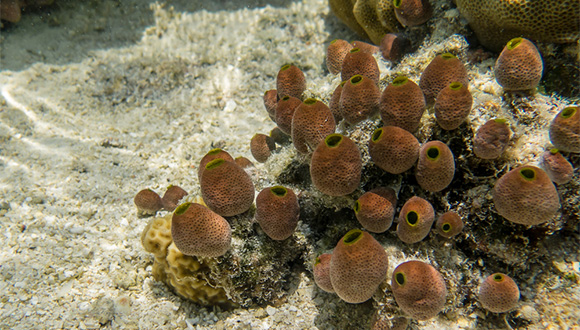 Did they take their medicine today? Ascidians
Prof. Shenkar and the researcher Gal Navon explain that various pharmaceuticals consumed by humans are not fully metabolized in the body, and high percentage of their active compounds are later excreted in their original form. In addition, lack of public awareness often results in the disposal of unused drugs in toilets or home garbage bins. Currently existing sewage treatment facilities are not suitable for the treatment of medication residuals, and, unlike other pollutants, their final concentrations at the endpoint of sewage treatment are not monitored. Eventually, a substantial amount of pharmaceuticals is discharged into the sea by sewage water. According to the research team, a variety of pharmaceutical residuals can be found in marine ecosystems worldwide – antibiotics, anti-inflammatory drugs, analgesics, anti-depressants and many more.
“Many of these compounds are very stable”, the researchers say, “These take a long time to degrade in the marine environment, and the damage they cause to marine life could be extremely excessive, since these pharmaceuticals are designed to affect biological systems (the human body). For example, various studies performed in different sites around the world have shown that Estrogen, present in birth control pills, leads to the development of female features in male fish in certain species, thus damaging their fertility; Prozac triggers increased aggressiveness and risk-taking in crustaceans; anti-depressants impair memory and learning in cuttlefish, and more”.
Prof. Avisar: “We have been studying the chemo-physical fate of drug residuals in groundwater and surface water for the past 15 years, and their detection in marine ecosystems has been surprising. The results indicate a chronic large-scale pharmaceutical residuals contamination, as well as the absorption of micro- and nano-pollutants, measured at very low concentrations in marine organisms”.
“Our study shows that Israel is no stranger to the global serious issue of seawater pharmaceutical contamination.”, Prof. Shenkar concludes. “The medications we use end up in the sea, mainly through sewage discharge, and cause great damage to the marine environment, indirectly affecting humans, who feed on sea foods that are exposed to such contamination. There are different ways to tackle this problem: on the individual level, we recommend that the population as a whole takes personal responsibility, disposing of unused pharmaceuticals into designated containers – which can be found at pharmacies and health maintenance organizations’ facilities. In addition, we are working to expand research on monitoring pharmaceutical contamination along the Israeli coastline, using advanced analysis of a greater variety of widely used medication, while examining the changes exerted upon the various organisms exposed to the environmental concentrations of those pharmaceuticals”.
Did they take their medicine today? Ascidians
Prof. Shenkar and the researcher Gal Navon explain that various pharmaceuticals consumed by humans are not fully metabolized in the body, and high percentage of their active compounds are later excreted in their original form. In addition, lack of public awareness often results in the disposal of unused drugs in toilets or home garbage bins. Currently existing sewage treatment facilities are not suitable for the treatment of medication residuals, and, unlike other pollutants, their final concentrations at the endpoint of sewage treatment are not monitored. Eventually, a substantial amount of pharmaceuticals is discharged into the sea by sewage water. According to the research team, a variety of pharmaceutical residuals can be found in marine ecosystems worldwide – antibiotics, anti-inflammatory drugs, analgesics, anti-depressants and many more.
“Many of these compounds are very stable”, the researchers say, “These take a long time to degrade in the marine environment, and the damage they cause to marine life could be extremely excessive, since these pharmaceuticals are designed to affect biological systems (the human body). For example, various studies performed in different sites around the world have shown that Estrogen, present in birth control pills, leads to the development of female features in male fish in certain species, thus damaging their fertility; Prozac triggers increased aggressiveness and risk-taking in crustaceans; anti-depressants impair memory and learning in cuttlefish, and more”.
Prof. Avisar: “We have been studying the chemo-physical fate of drug residuals in groundwater and surface water for the past 15 years, and their detection in marine ecosystems has been surprising. The results indicate a chronic large-scale pharmaceutical residuals contamination, as well as the absorption of micro- and nano-pollutants, measured at very low concentrations in marine organisms”.
“Our study shows that Israel is no stranger to the global serious issue of seawater pharmaceutical contamination.”, Prof. Shenkar concludes. “The medications we use end up in the sea, mainly through sewage discharge, and cause great damage to the marine environment, indirectly affecting humans, who feed on sea foods that are exposed to such contamination. There are different ways to tackle this problem: on the individual level, we recommend that the population as a whole takes personal responsibility, disposing of unused pharmaceuticals into designated containers – which can be found at pharmacies and health maintenance organizations’ facilities. In addition, we are working to expand research on monitoring pharmaceutical contamination along the Israeli coastline, using advanced analysis of a greater variety of widely used medication, while examining the changes exerted upon the various organisms exposed to the environmental concentrations of those pharmaceuticals”.


