Tag: Management

Did Israel’s “Basket” Initiative Lower Grocery Bills?

A new TAU study finds that while the government’s flagship cost-of-living program lowered prices on selected products, it was accompanied by price increases across dozens of other categories.

Researchers from the Coller School of Management at Tel Aviv University examined the Ministry of Economy’s flagship “Israel’s Basket” initiative and found that although it substantially reduced the prices of the 100 products included in the program, these reductions were accompanied by price increases across many other product categories. According to the researchers, the overall impact on consumers’ grocery bills may therefore have been considerably smaller than expected.

Looking Beyond the 100 Products

The study was conducted by Prof. Itai Ater and Adi Omer of the Coller School of Management at Tel Aviv University, together with Dr. Or Avishay-Rizhi of Pompeu Fabra University in Barcelona. Based on daily price data collected by the Pricez platform from approximately 70 supermarket chains and more than 2,000 stores across Israel, the researchers examined the program’s effects during its first seven weeks.

As part of the initiative, Carrefour committed to selling a basket of 100 products for a total price of NIS 1,098, compared with an average price of approximately NIS 1,700 before the program was launched. In return, the Israeli government allocated NIS 50 million to support a nationwide advertising campaign. The initiative operates in 50 Carrefour branches and on the company’s online shopping platform for a period of six months.

Analysis of more than 2,000 stores and Pricez data showed that prices of the designated basket products fell by approximately 35% in participating Carrefour branches. Prices also declined by approximately 6% in Carrefour branches that were not participating in the initiative, suggesting that some of the price reductions spilled over to other parts of the chain. On Carrefour’s online platform, basket products recorded an average price reduction of approximately 37%.

Carrefour in Israel

Lower Prices on Basket Products, Higher Prices Elsewhere

The researchers also examined price changes across product categories that were not included in the government’s basket.

Among participating Carrefour stores, prices increased in 46 of the 76 product categories examined, with 23 categories showing statistically significant increases. Notable examples included:

  • Laundry detergent and laundry gel – approximately 9%
  • Pudding, jelly, and whipped cream products – approximately 7%
  • Adult shampoo and conditioner – approximately 7%
  • Pasta, spaghetti, and lasagna – approximately 6%
  • Butter and flavored cookies – approximately 6%

The pattern was even more pronounced online, where prices increased in 55 product categories. Among the largest increases were:

  • Adult shampoo and conditioner – approximately 14%
  • Tea biscuits and crackers – approximately 9%
  • Laundry detergent and laundry gel – approximately 8%
  • Pasta, spaghetti, and lasagna – approximately 8%
  • Savory snacks – approximately 7%

The researchers also found price increases of approximately 1.5% to 2% for a range of other popular products that were not included in the government basket.

How Did Competing Supermarkets Respond?

Outside Carrefour, the program’s impact was considerably more limited. When the researchers examined physical stores across Israel’s supermarket chains, they found no statistically significant reduction in the prices of the designated basket products. Focusing specifically on the country’s major discount chains, they identified an average price reduction of approximately 3%.

Among the retailers:

  • Mahsanei HaShuk recorded the largest average reduction, at approximately 10%.
  • Half Hinam reduced basket prices by approximately 5%.
  • Yohananof lowered prices by approximately 4%.
  • Victory reduced prices by approximately 3%.
  • Rami Levy also lowered prices by approximately 3%.

By contrast, the researchers found no statistically significant price reductions at Shufersal Deal, Osher Ad, or Universe.

The online market showed a similar pattern. Competing retailers reduced the prices of basket products by an average of only 2.3%, with substantial differences between chains:

  • Rami Levy Online reduced basket prices by approximately 9%.
  • Half Hinam Online lowered prices by approximately 4%.

No significant price reductions were observed at Shufersal Online, the largest online grocery retailer in Israel, or at Mahsanei HaShuk Online.

Does Shopping Near a Carrefour Store Make a Difference?

National Pricing Rather Than Local Competition

The researchers also examined whether competing supermarket chains responded differently in areas where Carrefour stores participating in the initiative were located.

Their findings showed no meaningful differences between cities with participating Carrefour branches and those without them. According to the researchers, this suggests that Israel’s major supermarket chains set prices primarily at the national level, rather than competing store by store.

In other words, the presence of a nearby Carrefour branch offering discounted basket products did not lead competing supermarkets in the same city to lower their prices.

“There Are No Free Gifts in Economics”

Prof. Itai Ater concludes:

“There is no doubt that the program succeeded in lowering the prices of the designated basket products in the relevant Carrefour branches and also led to some price reductions among certain competitors. But in economics, there are no miracles and there are no free gifts.

“When you look beyond the 100 products at the center of the campaign, you see that these price reductions were accompanied by increases across dozens of other product categories. As a result, consumers who saved money on the basket products paid more for other items.

“The real test is not the price of a single product, but the total amount consumers pay at the checkout. From that perspective, it is possible that the effort to reduce the cost of the shopping basket ultimately produced the opposite result.”

Prof. Itai Ater (Photo: Oded Antman)

Prof. Itai Ater of the Coller School of Management is a leading researcher in the fields of competition policy, industrial organization, and public policy. His research examines the economic mechanisms that shape markets and influence consumers’ everyday spending.


Should Platforms Control Your Data?

Game theory shows data sharing benefits.

Researchers from Tel Aviv University used mathematical tools from game theory to show that in certain situations, allowing platforms to retain decision-making power over the collection and commercialization of their users’ data can enhance overall welfare. The study was conducted by Prof. Yaron Yehezkel from the Coller School of Management at Tel Aviv University, in collaboration with Prof. Sarit Markovich from Northwestern University in Illinois. The surprising findings were published in the Journal of Economics & Management Strategy.

 

Prof. Yaron Yehezkel. Photo credit: Israel Hadari, Tel Aviv University.

Prof. Sarit Markovich. Photo credit: Evanston Photographic Studios.

“Our research examined platforms that collect and commercialize user data”, explains Prof. Yehezkel. “For instance, when we search for information on Google, the platform can collect data about us. Similarly, when we listen to music on Spotify, Spotify can gather information about our habits. Platforms can choose to trade this data—for instance, selling it to advertisers who then use it to display targeted ads based on our activity on Google or Spotify. In this study, we asked: Who should have the right to impose the collection and sale of this data on users? Who benefits, who loses, and under what circumstances?”.

Data Privacy: American vs. European Models

Broadly, there are two approaches to this issue. The American model grants platforms full discretion over data collection and usage. When a user signs up for a platform, they agree to its terms, effectively relinquishing control over the data collected about them. Platforms are free to use the data as they see fit, and users who disagree can simply stop using the platform. The European model, in contrast, is embodied by the General Data Protection Regulation (GDPR). Under GDPR, users, not platforms, retain control over their data. Users can decide how their data is used while still being able to access the platform. This is why European users encounter consent pop-ups when browsing platforms like Google, allowing them to approve or deny various uses of their data. In Israel, the American model is the prevailing approach.

“The question we explored is which approach is better—giving users control over their data or leaving control with the platform”, says Prof. Yehezkel.

He continues: “Our study was mathematical and theoretical, rather than quantitative and empirical. We used game theory to model the behavior of users and platforms through mathematical utility functions that reflect societal benefit and company profit, aiming to identify the market’s equilibrium point”.

In their research, Prof. Yehezkel and Prof. Markovich were the first to demonstrate that data has not only economic value but also social value. “A platform that uses data it collects from me can provide better services to other users,” explains Prof. Yehezkel. For instance, Waze can sell user data to advertisers, but it also uses this data to guide other drivers to less congested routes. Similarly, Spotify can recommend music based on listening habits, age, and other preferences. Data can, therefore, have social value, benefitting society as a whole.

According to the researchers, the key question is identifying scenarios where data provides social value versus cases where its value is purely economic. “Data has a negative side when sold to third parties that infringe on our privacy, but it also has a positive side when used to improve platforms for the benefit of all users”, says Prof. Yehezkel. “Imagine a scenario where I use Waze to find the quickest route to Tel Aviv University but restrict the app from collecting information about my trip. The platform’s efficiency would drop, leading to longer traffic jams for everyone. Our model shows that in cases of low social value, the European approach has a clear advantage. However, in cases of high social value, particularly with less sensitive data, the American all-or-nothing approach offers significant benefits”.

Does Looking Good Lead to Doing Good?

New study finds that feeling attractive can lead to more generosity and kindness.

Does the global beauty trend have positive social aspects as well? A new study from Tel Aviv University shows that people who make an effort to improve their appearance—whether this effort is real or imagined, in the physical world or on social media—act more kindly towards others and are twice as likely to donate to charity.

The surprising study was led by Dr. Natalia Kononov, who completed her doctorate under the supervision of Prof. Danit Ein-Gar at the Coller School of Management at Tel Aviv University and is now a postdoctoral fellow at the Wharton School of Business at the University of Pennsylvania. The study, conducted in collaboration with Prof. Ein-Gar and Prof. Stefano Puntoni of Wharton, was published in the International Journal of Research in Marketing.

Prof. Danit Ein-Gar (Photo credit: Israel Hadari).

“When we enhance our appearance and feel beautiful—for example, after a fresh haircut—we behave in a more socially conscious manner”, explains Prof. Ein-Gar. “Why? Because we feel as though all eyes are on us, drawing attention, and so we strive to act better. It’s easy to criticize the selfie generation, constantly beautifying themselves and sharing polished photos, but we demonstrate a side effect of this behavior that can benefit society. People who feel good about their appearance can channel that feeling into good deeds”.

Dr. Natalia Kononov.

To test their hypothesis, the researchers conducted a series of experiments, some in virtual settings and others in a laboratory. In one lab experiment, participants were asked to use a filter to enhance a selfie they had taken. A control group, meanwhile, was asked to enhance a photo of an object in the room.

“The experimental group consisted of 50 participants, as did the control group”, Prof. Ein-Gar explains. “After viewing their enhanced photo, each participant collected an envelope with their payment in cash. Next to the payment envelope, there was a donation box so participants could voluntarily donate some or all of their payment. We observed that members of the experimental group, who saw themselves as more attractive, donated up to twice as much as those in the control group. It’s enough to imagine ourselves as more attractive—even just envisioning a more polished digital version of ourselves—to encourage prosocial behavior. This insight has significant practical implications. Until now, research has focused on the appearance of the donation seekers—whether the recipient or the fundraiser—and indeed, more attractive fundraisers have been found to raise more money. Our study introduces another relevant factor: the donor’s appearance. This opens the door to innovative strategies for streamlining charity campaigns, such as partnering with cosmetic companies, hairdressers, and beauty salons—for everyone’s benefit”.

Beauty and the Benefit

One of the most surprising experiments was conducted virtually, on Facebook. Clicking on a link randomly directed users to one of two “know yourself” questionnaires. The control group’s questionnaire asked about preferred architectural styles, while the experimental group’s questionnaire included questions about fashion styles and was designed to make respondents imagine themselves at their most attractive moments, such as envisioning themselves dressed up for a fancy social event. At the end of the questionnaire, a seemingly unrelated pop-up appeared with a link to a donation page. About 7% of respondents who answered the “beauty” questionnaire clicked on the donation link, compared to approximately 2% of those who answered the architectural questionnaire—a particularly impressive figure considering the average click-through rate on Facebook links is just 0.9%.

“Our society is obsessively focused on physical appearance while simultaneously criticizing this superficial behavior”, says Dr. Kononov. “People who are appearance-focused are often judged harshly, but we show that this behavior can have positive spillover effects that benefit others. Social mechanisms may evolve to create some balance, where behaviors that serve the individual are accompanied by byproducts that contribute to the greater good“.

Why Do Employees Keep Their Ideas from Their Bosses?

TAU research reveals that 1 in 4 employees hide their inventions from their employers.

A new study from the Coller School of Management at Tel Aviv University sheds light for the first time on an important issue in the business world: employees withholding their inventions from the companies they work for. Although the law and/or employment contracts typically grant organizations the rights to their employees’ inventions, invention withholding is quite common. It carries serious implications for businesses, especially in knowledge-intensive industries. The study reveals alarming data: one out of every four employees in commercial organizations has withheld an invention from their employer at least once. In many cases, this withholding is done deliberately, with the intent to use the invention after leaving the organization. The research was led by Dr. Sarit Erez, in collaboration with Prof. Yaniv Shani and Prof. Abraham Carmeli from the Coller School of Management at Tel Aviv University. The study was published in the prominent journal Academy of Management Perspectives.

Coller School of Management.

Dr. Erez explains: “Commercial organizations, particularly those in knowledge-intensive industries, encourage innovation among their employees, and their success largely depends on those employees coming up with groundbreaking inventions. To protect companies’ rights to these inventions, legal systems and standard employment contracts typically grant the employer ownership of inventions made by their employees, while requiring employees to disclose any invention they have come up with at work. This allows the employer to obtain patents and protect the invention. To increase employees’ motivation to disclose their inventions, many companies implement incentive systems, offering financial grants and/or recognition, such as badges of honor, to inventors. But at the end of the day, when an employee comes up with a new invention, they are faced with a behavioral dilemma: should they fulfill their legal obligation and disclose the invention to their employer, knowing they will lose ownership, or violate their obligation and hold on to the possibility of capitalizing on their invention outside the company? Indeed, it is a common scenario to see people leave one organization and either join another in the same field or even start their own company — often to develop an invention conceived in their previous workplace”.


Video Credit: Dr. Sarit Erez.


Who Really Owns the Work You Create?

Dr. Erez continues: “These types of cases often end up in court, where an employer sues a former employee — or their new employer — alleging that they are using an invention that the employee conceived while working for them and that the patent rightfully belongs to the original employer. Having practiced law in the private sector for about 20 years, I often represented employees, employers, or employee organizations in disputes of this type. It became evident that the legal tools currently used to address this issue are not the most effective approach. I used to believe that management tools were designed to increase employees’ willingness to disclose their inventions and reduce their tendency to withhold them could be far more effective. But when I looked for academic research on this subject, I found only a handful, and even those focused mainly on the withholding of inventions in academia rather than in commercial organizations. It became clear to me that the issue of withholding inventions, which is so vital to the growth of knowledge-driven companies, had not yet been thoroughly explored in management strategy. With this study, we aimed to shed light on this important phenomenon and begin to address it from a business perspective”.

For the study, the researchers distributed an anonymous online questionnaire, asking inventors to report whether they had ever withheld one or more inventions from their employers. Participants were also requested to describe the event, including its reasons and circumstances. A total of 199 valid responses were collected. Dr. Erez details the findings: “54 participants, or 27 percent of the respondents, reported withholding at least one invention from the organization in which they worked. Of these, 28 percent explicitly stated that they did so to develop the invention themselves after leaving the organization or bringing it as a sort of ‘dowry’ to their next employer. The others cited a variety of reasons, some psychological and some financial. These included an emotional attachment and sense of ownership over the invention as a personal creation; fear that someone else would take credit; conflict with their employer; lack of trust in management; dissatisfaction with pay; and the belief that they would not be adequately compensated for an invention that would profit the organization”.

Changing the Work Culture

In the next phase, the researchers developed a unique and validated measurement scale, the first of its kind, to assess employees’ tendencies to either disclose or withhold inventions from their employers. The findings revealed that withholding or disclosing inventions are not simply opposite sides of the same behavior, but rather two fundamentally different behaviors: an employee might refrain from disclosing a certain invention for a variety of reasons (such as a heavy workload or the belief that the invention still requires development and is not ready to be disclosed). However, a deliberate and active decision to withhold an invention in order to prevent the transfer of ownership to the organization is a distinct behavior that may be influenced by completely different factors (for example, the employee’s feeling that they are poorly treated by the company regardless of the invention itself). Dr. Erez explains: “This distinction is extremely important for organizations seeking to address the problem. Actions taken by companies today, such as offering financial incentives or recognition to inventors, may encourage more disclosures to the organization. However, such measures may be less effective for employees who deliberately withhold a promising invention with the intention of using it further down the road, outside the organization”.

According to the researchers, this newly developed scale can serve as a foundation for further studies on the subject. Additionally, it can help employers build an effective innovation management strategy that minimizes the withholding of inventions within the organization.

Dr. Erez concludes: “In this study, we conducted an in-depth exploration of a widespread phenomenon that has long concerned legal professionals around the world, but so far has hardly been examined from a managerial perspective: employees in the business sector who withhold their inventions from the company that employs them. We urge researchers in academia to continue investigating this important topic, and call on employers to take notice: these behaviors exist, and it is crucial to address them. For our follow-up studies, we are developing management tools to help employers tackle the issue in all its complexity. We believe that with the right management strategies, it is possible to encourage disclosure and significantly reduce the withholding of inventions — preventing the need for legal battles down the line”.

Free vs. Paid Real Estate: The Pricing Difference

Free real estate ads might cost you: Paid listings fetch thousands more.

Researchers from Tel Aviv University found that there may be a cost to the zero-price effect: statistically identical homes that were published in free service ads on the Israeli “Yad2” online classified service received fewer clicks, sold more slowly, and at a lower price than identical homes that were published in paid service ads – adding up to an average net loss of about 3.5%–3.8% of the average transaction price. This is equivalent to about $12K–$13K when the price of the paid service amounted to a total of about $70.

The surprising results were part of a study that was conducted by Prof. Danny Ben-Shahar, Director of the Alrov Institute for Real Estate Research at Tel Aviv University’s Coller School of Management and Dr. David Ash, a research associate at the institute. Its article reporting the results was recently accepted for publication in the journal Real Estate Economicsof the American Real Estate and Urban Economics Association.

Prof. Danny Ben-Shahar

“We study behavioral economics in the real estate market and, in particular, the effects of biases in decision-making,” explains Prof. Ben-Shahar. “We know for quite some time that people do not always make rational decisions, and one of the more interesting questions is whether there is a price paid for those irrational decisions. Here we examined a bias called the ‘zero-price effect’. This effect makes people overvalue products or services offered at zero price. For example, if we lower the price of a product from $2 to $1, demand may increase slightly, but if we lower its price by $1 to zero – demand will increase dramatically, which cannot be explained by a rational cost-benefit approach. We wanted to test this effect not in an experimental setting of the laboratory, but through real data of choices made in the ‘real world’ – and more importantly, to test whether there is an economic cost to this bias towards a zero price”.

Zero Price Bias: The Hidden Costs of Free in Real Estate Ads

In the first part of the study, the researchers examined commercial properties that were offered for rent on the “Yad2” online platform. In July 2019, the platform canceled the option to post ads for renting out commercial properties, and at the same time to charge more for the premium service – which both highlights the ad and displays it at the top of the search.

“This update allowed us to conduct a quasi-natural experiment, with the participation of real people who have to spend real money to rent out real properties,” says Prof. Ben-Shahar. “When the free service became fee-based and the premium service became even more expensive, we saw that a significant mass of owner, seeking to rent out their property, opted for the premium ad service – even though it became considerably more expensive. The cheaper option had lost appeal as soon as it stopped being completely free”.

Then Prof. Ben-Shahar and Dr. Ash demonstrated, for the very first time, the heavy price consumers pay for their zero-price bias. They did this by sampling over 15,000 ads of properties that private homeowners offered for sale on the “Yad2” platform, all of which are without brokerage, over the three years between 2014 and 2016.

“It’s important to realize that selling a home is the largest and most important deal in most people’s lifetime, averaging at $350K to $500K for the sellers in our sample,” says Prof. Ben-Shahar.

“’Yad2’ offers these private sellers to publish their ads in a free basic service, or in a premium service at a negligible total cost of about $70. However, about 95% of the sellers preferred the free ad service. Controlling for the difference in the characteristics of the assets, we found that the premium service increased the chance of selling the property by 10% to 18% daily, increased the number of clicks on the ad by 117% to 130%, and the clicks on the sellers’ phone number by 108% to 122%. In other words, those who paid for the premium service attained a higher demand and a faster sale. Most importantly: they sold their properties at higher prices. Statistically identical homes offered in the paid-premium service were sold for 3.5% to 3.8% higher price than homes provided in the free service, a difference of about $12K–$13K per sale”.

TAU Ranks 7th Globally for Graduate Entrepreneurship

TAU once again makes headlines in the 2024 PitchBook University Rankings.

Tel Aviv University shines once again in the 2024 PitchBook university rankings. According to the data, the university’s graduates impressively rank 7th globally in entrepreneurship, among the top 100 institutions worldwide, for the number of graduates who founded companies and raised capital.

This achievement highlights Tel Aviv University as the first non-U.S. institution to rank so highly in terms of alumni-founded startups and securing venture capital funding, and it stands as the only university outside the U.S. to make it into the top 10. Additionally, the MBA program at the Coller School of Management ranks 13th globally for producing the highest number of alumni founders.

This marks the third consecutive year that Tel Aviv University graduates have maintained their leadership in global entrepreneurship. A total of 814 alumni with undergraduate degrees from Tel Aviv University have founded 677 companies, collectively raising $26.5 billion in funding.

PitchBook’s annual university rankings, compiled by the renowned business information firm, compare schools by counting the number of alumni founders who have raised venture capital over the past decade.

Tel Aviv University’s graduate degree alumni are ranked 13th, with 354 founders who have launched 336 startups and raised $9.1 billion.

TAU Top Ranking in Female Entrepreneurs:

it ranks 21st globally for female undergraduate alumni and 17th globally for female graduate alumni who have founded companies and secured funding.

The rankings, conducted annually by PitchBook, are dominated by U.S. elite institutions, with Berkeley (1), Stanford (2), Harvard (3), and MIT (4) taking the top spots. Tel Aviv University outranks prestigious schools like Yale (11), UCLA (12), and Columbia (13).

According to PitchBook, three other Israeli universities made the prestigious list: The Technion is ranked 16th, Hebrew University 30th, Reichman University 42nd, and Ben Gurion University 47th.
 Read the full 2024 ranking list here >>

#TAU_WOMEN_POWER

Meet female researchers from Tel Aviv University who received the prestigious European Research Council (ERC) grants this year.

Four female researchers from Tel Aviv University received the prestigious European Research Council (ERC) grants, aimed to help promising mid-career researchers achieve their research goals. We spoke with the winners to hear how they feel about the award and hear any advice they may have for other aspiring researchers.

Prof. Miri Yemini | The School of Education at TAU’s Faculty of Humanities 

In her research, Yemini explores how young people from different backgrounds in different countries understand and appropriate global citizenship.

How did you feel when you heard that you’d be awarded the grant?

“I was very excited when I received the news about the grant. At the same time, I understand that winning the grant is just the beginning. It marks a long road ahead, with research and action, fueled by curiosity and perseverance.”

This year, the majority of TAU’s ERC grant recipients are female. How do you feel about that?

“I am happy for all the recipients and look forward to future updates on their research and results. I am eager to see more women in senior positions at Israeli universities, both in academic and administrational positions. I would also like to see a more diverse academia in terms of gender, religion, ethnicity, first-generation academics and more. We still have a long way to go in this respect.”

Do you have a personal message for young female researchers at the beginning of their career?

“To win a grant, you first need to submit. For me, it has been helpful to filter out fears and hesitations and focus on what interests and excites me research-wise. It is also important to bear in mind that behind most such achievements are at least twice as many failures – and these don’t tend to make the headlines.”


Prof. Miri Yemini

Prof. Limor Landsman | The Cell and Developmental Biology Department of TAU’s Sackler Faculty of Medicine

Landsman researches the function of beta cells, cells that regulate insulin production, crucial for blood sugar control and for the prevention of diabetes. Her team studies how beta-cell function and mass are established and maintained in healthy individuals and why they are lost in instances of diabetes.

How did you feel when you heard that you won the grant?

“I felt happy and proud, but most of all relieved that my lab will be funded in the coming years, so that I can continue to advance our research in a direction that I believe will lead to new insights into diabetes.”

This year, most TAU’s ERC grant recipients are female. How do you feel about that?

“I am proud to be part of an academic institution that advocates excellence, of both women and men.”
 

Do you have a personal message for young female researchers at the beginning of their career?

“What I like about research is that nothing is known in advance, for better and for worse. That’s why I think it’s important not to be afraid to try, even if the chances are low. Did it work? Great! If it didn’t – allow yourself to be upset for a day or two and then dust if off and try a different direction.” 


Prof. Limor Landsman


Prof. Hila Shamir | Tel Aviv University – The Buchmann Faculty of Law

Shamir teaches and researches Employment, Labor, Immigration, and Welfare Law with a focus on issues of human trafficking, gender equality, informal work, and the law of global value chains. She is a second time ERC grant winner, and as part of her first ERC grant, she established the research group TraffLab: Labor Perspective to Human Trafficking.

In her current research, Shamir examines efforts to promote workers’ rights in global supply and production chains.

How did you feel when you heard that you’d be awarded the grant?

“I was very excited. This is the second time I receive an ERC grant, and I assumed that my chances were low as a result. So, the surprise of receiving the grant this year was great. I also feel an accompanying weight of responsibility and the desire to ensure efficient use of such a significant amount.”

This year, most of TAU’s ERC grant recipients are female. How do you feel about that?

“Very happy and not at all surprised. There are wonderful female researchers in the Israeli academia, and it is great to see their work receiving international recognition.”

Do you have a personal message for young female researchers at the beginning of their career?

“Don’t be afraid to submit a grant application, even if it may seem intimidating initially. Do invest some time on the submission, as a grant of this scale has the potential to greatly change the way we conduct research: it makes it possible to build a large research group; secure funding for researchers at the beginning of their career and enables significant research scope with a correspondingly strong potential to influence. Even if you should not end up winning, the attempt to think big and imagine research on such a scale is valuable in and by itself and could bear fruits further down the line. Good luck!”


Prof. Hila Shamir

We wish our female rockstars congrats and good luck with their current research!


 Established in 2007 and annually awarded by the European Union, the ERC research grant is considered one of the most prestigious and important ones in the world of science. The four main types of ERC grants are: ERC Starting Grant, ERC Consolidator Grant, ERC Advanced Grant and the ERC Synergy Grant.

Are You an Entrepreneur at Heart?

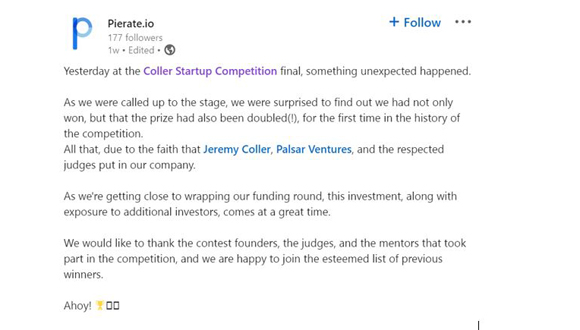
Join the Coller Startup Competition 2023 for the chance to win $100,000 for your startup.

Tel Aviv University’s Coller School of Management invites students and alumni to submit (and continue to update) your submission until May 10, 2023.

Selected ventures will receive valuable feedback on their startup and get the chance to win an investment of $100,000 for their startup.


Get more details and register here >> 

Featured image: Dr. Eyal Benjamin (far left) and Prof. Moshe Zviran (far right) with last year’s winning teams

Coller School of Management Among World’s Top 100 Business Schools

 The only Israeli business school included in ranking by CEOWORLD Magazine.

Tel Aviv University’s Coller School of Management was ranked among the 100 “Best Business Schools in The World For 2023”  by CEOWORLD Magazine, the only Israeli school to be included in this comprehensive international ranking. The ranking was conducted through the 2023 Global Business Schools survey among thousands of senior executives around the world and mentioned 500 selected schools among the 13,000 business administration schools operating in the world. Coller School of Management came in on the 99th place.

The ranking is based on seven main indicators of quality and reputation, including academic reputation, admission eligibility conditions, job placement rate, recruiting employer feedback, specialization reputation and global influence, as well as tuition fees and payments.  

Prof. Dan Amiram, Dean of the School of Management, says that the impressive ranking reflects “the hard work and dedication of hundreds of people – researchers, lecturers, students and alumni – who have all contributed to the extensive work which has earned the School its solid reputation over many years. We are very proud of the extraordinary achievements of our students and alumni, as well as the positive feedback and the international appreciation which we receive.”


Prof. Dan Amiram, Dean of Tel Aviv University’s School of Management

CEOWORLD Magazine conducted the survey among 35,000 business managers, alumni, international business influencers, industry professionals, business school academics and employers and recruiters in 156 countries, in the period between September 15 – December 22, 2022. 10% of the interviews were conducted by phone, 82% online and 8% by mail or in person. All quantitative interviews were conducted confidentially, without relying on the submission of data by the academic institutions.

This ranking follows shortly after the Pitchbook ranking for 2022 which placed TAU as number seven in the world for entrepreneurship, and on first place outside the U.S.

Men Engage in “Chivalrous Sexism” when Donating to Women in Need

New study finds that men are less willing to help women if the help will empower them.

A new study by Tel Aviv and Ben-Gurion Universities reveals a phenomenon of “chivalrous sexism” towards women in need. According to the study, about 2 out of 3 men (62%) would be willing to help a woman in distress whose house burned down – but fewer men (45%) would donate money to a woman whose business burned down. On the other hand, when the researchers examined the willingness of men to donate to other men, the trend that emerged was the opposite – according to which most men preferred to donate to men whose business was burned thus maintaining the male hegemony.

The researchers explain the differences by the fact that men tend to help women out of ‘chivalrous sexism’: helping a ‘damsel in distress’ is part of a men’s gender role, which is why a man will open the door for a woman or pull over to help her change a flat tire. But this help depends on the context: men help women if it does not challenge the male hegemony, in other words, if their help will empower women, then men will be less willing to help them.

The new study was conducted by Prof. Danit Ein-Gar from the Coller School of Management at Tel-Aviv University in collaboration with Dr. Orli Barkat, a post-doctoral student at Princeton University, and Prof. Tahila Kogot from Ben-Gurion University. The results of the study were published in the prestigious journal Group Processes & Intergroup Relations.


“When men were asked to donate, some of them found it easier to donate to a woman in her domestic, needy, and weak place than to a woman raising funds to rebuild her business.” Prof. Danit Ein-Gar 


The Limitation of Male ’Chivalry’

According to Prof. Ein-Gar, 566 men and women from the USA participated in an online experiment. A cash prize of 10 dollars was drawn among the participants in the experiment, and the participants were asked to answer whether they would like to donate this amount to a man whose house burned down, to a woman whose house burned down, to a man whose business burned down, or to a woman whose business burned down.

Beyond the disparity in willingness to help women whose business burned down, compared to those whose house burned down, the findings also show that men donated an average amount of $4 (almost half of the winning amount) to a woman whose house burned down, compared to only $2.48 to a woman whose business house burned down.

The findings were replicated in another experiment conducted among management students at Tel Aviv University.


Prof. Danit Ein-Gar from the Coller School of Management at Tel-Aviv University

“We presented the participants with two identical requests for help from two individuals in need, a man and a woman, whose home or business caught fire,” explains Prof. Ein-Gar. “We found that the biggest differences, both in the actual willingness to donate and the donation amount, were when male subjects had to choose between helping a woman’s home and helping a woman’s business.”

“It should be noted that we did not present the fund request as a financial investment but rather as a donation: a fire raged in the area and consumed houses and shops, and now those in need are asking for help to rebuild their lives. When men were asked to donate, some of them found it easier to donate to a woman in her domestic, needy, and weak place than to a woman raising funds to rebuild her business”.

Prof. Ein-Gar explains that the new research reveals the boundaries of male ’chivalry’ – and these boundaries are set by men’s hegemony in the business world. That is, gentlemanliness reaches up to the point where it does not threaten their dominant status. A similar effect was not found when men were asked to donate to another man whose business burned down, compared to a man whose house burned down. This means that men do not donate less to businesses due to some business threat, but only donate less to women’s businesses.

Victoria

Phone: +61 3 9296 2065
Email: office@aftau.asn.au

New South Wales

Phone: +61 02 7241 8711
Email: admin@aftau.org.au

Western Australia

Phone: :+61 0418 46 5556
Email: davidsolomon@aftau.org.au